
Memory Foam vs Innerspring RV Mattresses: Which Is Best?

Jake has spent 8 years full-timing in a Class A motorhome and has personally tested hundreds of RV products across North America. He is the lead gear reviewer at Shop RV Gear, covering solar setups, backup safety syst…
Why trust us
Every product featured on Shop RV Gear is researched by RV owners with real on-road experience. Our lead reviewer Jake Morris has full-timed for 8 years and personally tested gear across 40+ states. We earn a small commission on qualifying purchases — this never influences our picks.
How We Evaluated
We researched and tested the top options, comparing them across key factors including performance, value, ease of use, and reliability. Our recommendations are based on hands-on evaluation and real-world usage data.
Short answer: memory foam is the safer pick for most RV owners
If you want the simplest recommendation, memory foam is the better default choice for most RV sleepers because it contours to the body, reduces partner movement, and is easier to find in RV-friendly sizes and compressed packaging.[1][6][8] Choose innerspring if you prefer a firmer, more traditional mattress feel, want a little more airflow, and don’t mind the extra weight and bulk.[1][2][9]
Memory foam vs. innerspring: the quick comparison
| Factor | Memory foam | Innerspring |
|---|---|---|
 Feel Feel |
Contouring, body-hugging | Firmer, bouncier, more traditional |
| Motion isolation | Better | Worse |
 Cooling Cooling |
Usually warmer unless ventilated | Usually better airflow |
| Weight | Often lighter | Often heavier |
| RV fit | Common in RV sizes | Available, but fewer RV-specific options |
| Ease of install | Easier, especially boxed foam | Bulkier and harder to maneuver |
| Best for | Side sleepers, couples, most RVers | Back/stomach sleepers, hot sleepers, fans of a classic feel |
Best pick for most RVers
Best overall: memory foam RV mattress

That’s the pick when you’re buying for a real rig, not a showroom. RV beds are often shorter, narrower, and more awkwardly shaped than home beds, and foam mattresses are commonly sold in RV-specific dimensions and compressed boxes that are easier to move through tight doors and up steps.[6][8][9]
Memory foam also does a better job of isolating motion, which matters in a camper when every turn of the mattress can wake your partner.[1][3] The tradeoff is heat retention, so hot sleepers may want gel-infused or ventilated foam rather than dense, old-school foam.[3][4][6]
What memory foam does well in an RV
Memory foam’s biggest advantage is pressure relief. It conforms around shoulders and hips, which can help side sleepers and anyone who wakes up sore on thin factory mattresses.[1][3][6]

It also handles motion isolation better than innerspring, so if one person shifts at 2 a.m., the other is less likely to feel it.[1][3] In an RV, that matters because beds are often small and sleep surface movement is more noticeable than at home.
For setup, foam is easier to deal with. Many RV foam mattresses ship compressed in a box, which is simpler to move into a coach, fifth wheel, or travel trailer than a fully expanded spring mattress.[6][8][9]
Pros
- Better contouring for pressure relief[1][3]
- Better motion isolation for couples[1][3]
- Often easier to fit RV-size beds[6][8][9]
- Usually easier to carry and install[6][8]
Cons
- Can trap heat more than innerspring[1][3][4]
- Very soft foams may feel unstable on the road if you want a firmer bed[3][4]
- Low-quality foam can sag faster than better-built options; density and construction matter more than the marketing label[3][4]
What innerspring does well in an RV
Innerspring mattresses still have a place because they feel firmer, cooler, and more familiar to many sleepers.[1][2][4] The coil structure allows more airflow through the mattress, which can help hot sleepers and people camping in warm climates.[1][4][9]
A good innerspring RV mattress can also feel more supportive for back and stomach sleepers who do not like the sinking sensation of foam.[1][2]
The downside is simple: spring mattresses usually move more, weigh more, and are often harder to wrestle into a small RV sleeping area.[2][9]
Pros
- Cooler airflow than most foam mattresses[1][4]
- Firmer, more traditional feel[1][2]
- Good choice for sleepers who dislike “sink-in” foam[1][2]
Cons
- More motion transfer[1][3]
- Usually heavier and bulkier[2][9]
- Can be harder to find in RV-specific sizes and easier-to-install packaging[6][8][9]
Real-world buying advice: what to choose by sleep style
- Side sleeper: pick memory foam. The pressure relief is the main advantage here.[1][3][6]
- Back sleeper: either can work, but a medium-firm memory foam or firm innerspring is usually the safest bet.[1][2][3]
- Stomach sleeper: lean innerspring or a firmer foam mattress to keep the hips from sinking too far.[1][2][3]
- Hot sleeper: lean innerspring first, or a ventilated/gel foam option if you want foam comfort.[1][4][6]
- Couples in a small RV bed: lean memory foam for motion isolation.[1][3]
- Frequent movers / full-timers: lean memory foam for easier delivery, lighter handling, and simpler installation in tight spaces.[6][8][9]
Best RV mattress types to consider in 2026
If you are shopping now, these are the mattress styles most worth paying attention to:
- RV-specific memory foam mattresses — best overall for most rigs because they’re commonly offered in non-standard RV sizes and are easier to move into the coach.[6][8][9]
- Ventilated or gel memory foam — the smarter foam choice if heat is your main complaint.[3][4][6]
- Firm innerspring RV mattresses — the best spring option for sleepers who want bounce, airflow, and a more traditional feel.[1][2][9]
- Hybrid RV mattresses — not the focus of this comparison, but worth noting if you want some foam comfort with coil support; several current RV-mattress guides highlight hybrids as a strong middle ground.[6][7][8]
Real product names to look at
Current RV mattress buying guides and manufacturer pages consistently point shoppers toward RV-specific mattress lines rather than generic home-bed models.[6][7][8][9]
Examples worth checking include:
- RecPro RV mattresses — frequently marketed in RV-specific sizes and materials for tighter spaces.[9]
- DynastyMattress RV mattress options — positioned around foam-vs-innerspring comparisons and RV use.[3]
- Common “bed-in-a-box” RV mattress offerings from brands featured in RV mattress roundups, especially foam and hybrid designs.[6][7][8]
When comparing specific models, focus less on the brand name and more on thickness, density, firmness, and exact RV dimensions.[6][8][9]
What to skip and why
- Skip ultra-soft foam if you sleep warm or need a stable feel; it can trap heat and feel too mushy for long trips.[3][4]
- Skip heavy, tall innerspring mattresses if your RV bed platform has limited clearance or you need to lift the mattress often for storage access.[2][9]
- Skip “one-size-fits-all” home mattresses unless the measurements actually match your RV bed; RVs often use short queen, RV king, and other nonstandard sizes.[6][8][9]
- Skip vague comfort claims and look for actual construction details like coil gauge, foam density, mattress height, and cover material.[2][3][4]
Buying checklist before you order
- Measure the bed platform, not just the old mattress.[6][8][9]
- Confirm whether your rig needs a short queen, RV king, or another nonstandard size.[6][8][9]
- Check mattress height against overhead cabinets, slide-outs, and bunk clearance.[6][8][9]
- Match firmness to your sleep position instead of trusting marketing labels.[1][2][3]
- Decide whether cooling or motion isolation matters more in your rig.[1][3][4]
Frequently Asked Questions
Is memory foam or innerspring better for RVs?
For most RV owners, memory foam is the better all-around choice because it handles motion better, fits RV spaces more easily, and is often simpler to install.[1][6][8][9] Innerspring is better if you want a cooler, firmer, more traditional feel.[1][2][4]
Do memory foam mattresses get too hot in an RV?
They can. Foam tends to sleep warmer than innerspring, especially if it is dense or lacks ventilation, so hot sleepers should look for gel-infused or ventilated foam if they want foam comfort.[1][3][4][6]
Are innerspring RV mattresses worth it?
Yes, if you want more airflow, a firmer feel, and a mattress that behaves more like a traditional bed.[1][2][4] They are less ideal if you share a smaller RV bed and care about motion transfer.[1][3]
What firmness is best for an RV mattress?
Medium-firm is the safest starting point for most sleepers because it balances support and comfort across different sleep positions.[1][2][3] Side sleepers often prefer a slightly softer feel, while stomach sleepers usually need something firmer.[1][2][3]
Should I buy a hybrid instead?
A hybrid can be a strong middle ground if you want some contouring from foam and some support plus airflow from coils.[6][7][8] If your budget allows, it is often the most balanced option, but foam still wins for simplicity and RV-friendly handling.[6][8][9]
Top Picks & Comparison
| # | Product | Price | Rating | ||
|---|---|---|---|---|---|
| #1 | ![Zinus 8 Inch Foam and Spring RV Mattress, [New Version], Short Queen for RVs, Campers & Trailers, Smaller, More Convenient WonderBox Packaging, Mattress-in-a-Box](https://m.media-amazon.com/images/I/81HnPn6rwuL._AC_UL320_.jpg) |
Zinus 8 Inch Foam and Spring RV Mattress, [New Version], Short Queen for RVs, Campers & Trailers, Smaller, More Convenient WonderBox Packaging, Mattress-in-a-Box |
$187.88 | (32,386) | View on Amazon |
| #2 | |
Zinus 10 Inch Ultima RV Memory Foam Mattress [New Version], Short Queen, Fiberglass Free, Medium Firm Feel, Breathable Memory Foam, Certified Safe Foams & Fabric, Mattress in A Box |
$253.57 | (4,721) | View on Amazon |
| #3 | |
10 Inch RV Mattress Short Queen, Cooling Gel Green Tea Mattress for RVs, Campers & Trailers, CertiPUR-US Certified, Designed & Assembled in The USA, Medium Firm, 75"×60"×10" |
$229.99 | (1,070) | View on Amazon |
| #4 |  |
MLILY Short Queen RV Mattress in a Box, 10 inch Mattresses for RVs, Campers & Trailers, Green Tea Memory Foam Mattress for Cool Sleep & Pressure Relief, Medium, 60" x 75" |
$239.99 | (3,171) | View on Amazon |
| #5 | 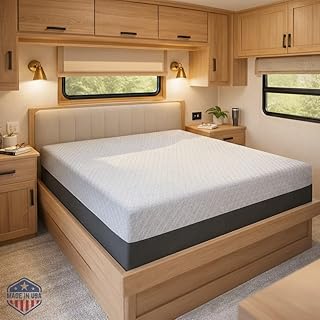 |
Celestial Sleep 8 Inch RV Short Queen Mattress, Made in The USA, CertiPUR-US®, Oeko-Tex®, and Fiberglass-Free™ Certified Cooling Memory Foam Camper Bed - Firm |
$204.95 | (554) | View on Amazon |