
Best RV Water Pressure Regulators to Protect Your Plumbing

Jake has spent 8 years full-timing in a Class A motorhome and has personally tested hundreds of RV products across North America. He is the lead gear reviewer at Shop RV Gear, covering solar setups, backup safety syst…
Why trust us
Every product featured on Shop RV Gear is researched by RV owners with real on-road experience. Our lead reviewer Jake Morris has full-timed for 8 years and personally tested gear across 40+ states. We earn a small commission on qualifying purchases — this never influences our picks.
How We Evaluated
We researched and tested the top options, comparing them across key factors including performance, value, ease of use, and reliability. Our recommendations are based on hands-on evaluation and real-world usage data.
⚡ Quick Picks
- #1 RVGUARD RV Water Pressure Regulator Valve, CSA Approved, Lead-Free Brass Adjustable Water Pressure Reducer with Gauge and Inlet Screen Filter for RV Camper Travel Trailer $29.99 View on Amazon →
- #2 Renator RV Water Pressure Regulator for RV Camper. Brass Lead-free Adjustable Water Pressure Regulator with Gauge for Camper Travel Trailer, Reducer Valve W Filter. M11-0660R. $28.80 View on Amazon →
- #3 Camco Brass Marine/RV Water Pressure Regulator – Protects RV Kitchen Small Appliances, Plumbing & Hoses – Reduces RV Water Pressure to Safe & Consistent 40-50 PSI – Drinking Water Safe (40055) $12.24 View on Amazon →
Short answer: the best RV water pressure regulators for most campers
If you only read one section, here’s the bottom line: every RV should have a water pressure regulator installed at the campground spigot before the hose.[5][3] Campground water can easily spike to 80–100 PSI, while most RV plumbing is designed for about 40–60 PSI.[5][1] That’s how people end up with burst PEX, leaking faucets, or a trashed water heater after “just one hookup.”
For most RVers, the sweet spot is a brass adjustable regulator with a built‑in gauge set around 45–50 PSI.[1][3] These give you safer pressure, solid flow for showers, and let you dial things in for older rigs with weaker plumbing. If you’re on a tight budget or hate fiddling with knobs, a simple fixed 40–50 PSI regulator still beats running unregulated.

Below you’ll find the best regulators I’d actually put on my own rigs right now, based on current models, specs, and recent owner feedback, plus clear notes on what to skip and why.
How RV water pressure regulators work (and why they matter)
Campground and municipal systems are designed for buildings, not RV plumbing. It’s common to see pressures all over the map — from a weak 25 PSI trickle to 100+ PSI.[2][5] Your RV’s PEX, fittings, toilet valves, and water heater were never meant for that.
An RV water pressure regulator:

- Screws between the campground spigot and your hose, so it’s the first thing in line.[5][1]
- Uses an internal spring and diaphragm to reduce incoming pressure down to a safe level before it ever reaches your RV.[7][3]
- Often includes a pressure gauge so you can confirm you’re in the safe 40–50 PSI range most RVs are designed around.[1][3]
Without one, you’re rolling the dice that every campground has perfectly tuned pressure. Experienced RV techs will tell you: the cost of a regulator is tiny compared to repairing soaked subfloors or replacing a water heater.[8]
Best RV water pressure regulators: top picks
Note: product names, specs, and typical price ranges are based on current listings and recent reviews as of the most recent season. Prices fluctuate, so always check live pricing before you buy.
1. Best overall: Valterra A01‑1117VP Adjustable Water Regulator with Gauge
If you want one regulator that works for almost any RV, the Valterra A01‑1117VP is the workhorse pick many long‑term RVers settle on and stop thinking about.[7] It’s an adjustable brass regulator with an integrated gauge, designed specifically for RV use.
Why it’s my first recommendation
- Adjustable: lets you dial in an outlet pressure in the 40–50 PSI sweet spot, or a bit lower for older rigs.[1][3]
- Built‑in gauge: gives you a real‑time PSI readout at the spigot, so you know what the campground is sending and what you’ve set.[7]
- Durable brass body: better long‑term corrosion resistance than cheap pot metal regulators.[3][4]
- Widely available, with lots of real‑world RV feedback and replacement parts.
Best for: RVers who camp regularly (weekenders through full‑timers) and want a set‑and‑forget solution that can adapt to different campgrounds and rigs.
Pros
- Adjustable outlet pressure with a simple screw/knob[7]
- Clear gauge for monitoring campground and regulated pressure[7][3]
- Brass construction handles outdoor use and treated water better than plastic[3][4]
- Widely used in the RV community; easy to find how‑to guidance and support
Cons
- Costs more than basic fixed regulators
- Gauge is exposed — can be damaged if you drop or overtighten
- Like all gauges, may eventually need replacement if it fogs or sticks
2. Best budget fixed regulator: Camco brass inline 40–50 PSI regulator
If you just want basic protection at the lowest possible cost, a fixed‑pressure brass inline regulator like the popular Camco models is still far better than running unregulated.[4][8]
These compact regulators are preset to about 40–50 PSI, which lands right in the safe zone for most RV plumbing.[1][4]
Best for: New RVers building out a kit on a budget, or anyone who wants zero fiddling and doesn’t care about fine‑tuning.
Pros
- Very affordable compared with adjustable regulators[4]
- Simple: no settings, no knob, and usually no gauge to break
- Brass body handles chlorinated and hard water better than plastic[3][4]
- Compact and lightweight; easy to leave on the hose
Cons
- No gauge — you can’t see campground pressure or confirm output
- Non‑adjustable: you’re stuck with the preset pressure
- Some units can reduce flow noticeably at campgrounds with already low pressure[2]
Skip it if: You boondock a lot, move camp frequently, or are picky about shower pressure. The lack of a gauge and adjustment will frustrate you long‑term.
3. Best high‑flow adjustable regulator for full‑timers
Several brands now sell high‑flow adjustable brass regulators with integrated gauges designed specifically for RV and tiny‑home use.[4][9] These follow the same basic pattern as the Valterra pick above but focus on maintaining full flow while still limiting pressure.
Look for:
- All‑brass construction
- Lead‑free certification for potable water
- Adjustable pressure up to 80–100 PSI (for use where you need higher pressure but still want a limit)[4]
- Side‑mounted, oil‑filled gauge for easier reading and better durability
Best for: Full‑timers and families in larger rigs (class A, fifth wheels) who want strong shower flow and use multiple fixtures at once.
Pros
- Higher flow design helps prevent the “trickle shower” syndrome at safe PSI
- Adjustable and repeatable pressure settings[4]
- Often include replaceable, higher‑quality gauges
Cons
- Typically the most expensive style on this list
- Larger and heavier than basic fixed regulators
- More seals and connections mean more potential leak points over many seasons
4. Simple option for seasonal use: inline fixed regulator with external gauge
Some RVers prefer to keep the regulator itself simple and use a separate pressure gauge at the spigot. This lets you:
- Use an inexpensive fixed 40–50 PSI regulator for safety
- Add a hose‑end pressure gauge when you’re curious about a particular campground’s pressure or want to double‑check the regulator[3]
Best for: Seasonal or occasional campers who want a budget setup but still like to see what the campground is sending.
Pros
- Spreads cost over two simple components
- Easy to replace either piece if one fails
- Lets you use the same gauge to check other water outlets around the RV or house
Cons
- More parts to keep track of
- Extra connection adds another potential leak point
- Not as compact as an all‑in‑one adjustable unit
Key features that actually matter
There’s a lot of marketing fluff around regulators. Here’s what’s worth paying attention to — and what I’d ignore.
1. Adjustable vs fixed pressure
Adjustable regulators let you set outlet pressure (usually up to 60–80 PSI) with a screw or knob and confirm it on the gauge.[4][3] This is ideal if:
- You move camp often and see wildly different pressures
- You have an older rig and want to run lower PSI
- You’re picky about shower performance
Fixed regulators are preset at the factory, commonly to 40–50 PSI.[1][4]
- Great for "install it and forget it" users
- Less to break, cheaper, but no tuning
If you can stretch the budget at all, adjustable with a gauge is the most future‑proof choice.[2][4]
2. Material: brass vs plastic
Most good regulators are brass or stainless steel.[3]
- Brass is the go‑to: strong, corrosion‑resistant, and commonly rated for potable water.[3][4]
- Plastic regulators exist but are more prone to cracking from UV, over‑tightening, or freezing.
For something that lives outside at a pressurized connection, brass is worth the extra dollars.[3]
3. Gauge quality and placement
A gauge is hugely helpful, but not all are created equal:
- Integrated gauges on RV‑specific regulators make setup easy — you see both campground and regulated pressures at a glance.[7][5]
- Look for clear markings in the 0–100 PSI range; the most important part is that 40–60 PSI zone.[1][4]
- Oil‑filled or vibration‑resistant gauges hold calibration longer, especially if your regulator lives on the hose.
Gauge fogging or failure over time is normal; many RVers simply replace the gauge instead of the entire regulator when that happens.
4. Flow rate / “high‑flow” claims
Manufacturers talk about “high flow” but rarely publish real gallons‑per‑minute numbers.[2][4] In practice:
- Any pressure regulator will reduce flow somewhat, especially if the campground pressure is low to begin with.
- High‑flow adjustable regulators are designed with larger internal passages and smoother flow paths to minimize that loss.
If you often shower while running the washer or dishwasher, or have a big rig with multiple bathrooms, spending more for a high‑flow adjustable model is worth it.[2][4]
How to install and use an RV water pressure regulator
The good news: installing a regulator is dead simple. You don’t cut any pipes; you just screw it on like a hose fitting.
Correct hookup order
Most RV experts and guides recommend this setup:[5][3]
Campground Spigot → Regulator → Hose → RV City Water Inlet
This way, your hose and your RV are both protected from excessive pressure.[5]
Step‑by‑step setup
- Turn off the spigot completely.
- Attach the regulator to the campground faucet/spigot.
- If it’s adjustable, set an initial pressure around 45–50 PSI using the screw or knob.[1][3]
- Connect your drinking‑water‑safe hose to the outlet side of the regulator.[1]
- Connect the other end of the hose to your RV city water inlet.
- Slowly turn on the spigot while watching the gauge (if present) for sudden spikes.[3][5]
- Check for leaks at all connections; snug them up as needed.
- Adjust pressure slightly if your rig prefers a bit more or less, staying within the typical 40–60 PSI safe range.[5]
Basic maintenance
- Don’t leave water on all season if you’re away: shut off the spigot to reduce stress on seals.
- Winterize: remove the regulator and store it somewhere it won’t freeze; freezing can crack internal components.
- Occasionally back‑flush by reversing the flow briefly (where design allows) to clear debris from the inlet screen.
- Inspect the gauge for fogging or sticking; replace it if readings no longer make sense.
What to skip (common mistakes and bad buys)
Based on real‑world RV use and repair shop horror stories, here’s what I’d avoid:
Camping without a regulator “just this once”
The campground that looks the most polished on the surface can be the worst offender for water pressure spikes. Regulators are cheap insurance compared to plumbing repairs.[8]Ultra‑cheap plastic regulators with no specs
If the packaging doesn’t clearly state the set PSI and material, skip it. Unknown limits and plastic bodies are a bad mix for something protecting your plumbing.[3]Household pressure‑reducing valves not rated for RV/portable use
Some people try to adapt whole‑house regulators from the hardware store. Unless you know exactly what you’re doing and can confirm potable‑water and pressure ratings, stick to RV‑specific units.[3][4]Running a gauge alone without a regulator
A gauge tells you the pressure, but it doesn’t limit it. You need both information and control.[2][3]
Frequently Asked Questions
Do I really need a water pressure regulator for my RV?
Yes. Campground water systems can easily exceed 80–100 PSI, while most RV plumbing is only designed for 40–60 PSI.[5][1] A regulator is the simplest way to prevent burst lines, damaged faucets, and water heater failures, and it stays on the outside of the rig.[5][8]
What PSI should I set my RV water pressure regulator to?
Most RV owners aim for around 45–50 PSI.[1][3] That’s high enough to give decent shower performance but low enough to protect typical RV plumbing. If you have an older rig, start closer to 40 PSI and increase slightly only if needed, staying at or under your manufacturer’s recommendation where available.[4][5]
Where should I install the regulator — at the spigot or at the RV?
Install it at the campground spigot, before the hose.[5][3] That way, both your hose and your RV’s plumbing are protected from pressure spikes, and you can easily see and adjust the gauge without crawling under the rig.[5]
Does a water pressure regulator reduce water flow?
Any regulator can reduce flow, especially at low campground pressures, because it’s restricting the line.[2][4] However, a high‑flow adjustable regulator is designed to minimize that loss, so you still get strong shower performance while staying within a safe PSI range.
Can I leave my RV water pressure regulator on the hose all the time?
Many RVers do, but it’s better to remove and store it when traveling or winterizing. Leaving it outside full‑time exposes the gauge and seals to more UV, dirt, and freezing risk, which can shorten its life.[3][5]
If you’re building or upgrading your water setup, start with a brass regulator (ideally adjustable with a gauge) and a drinking‑water‑safe hose. From there, you can fine‑tune filters and softeners, but that one small regulator is what keeps your plumbing safe when campground water gets rowdy.
All Picks & Comparison
| # | Product | Price | Rating | ||
|---|---|---|---|---|---|
| #1 |  |
RVGUARD RV Water Pressure Regulator Valve, CSA Approved, Lead-Free Brass Adjustable Water Pressure Reducer with Gauge and Inlet Screen Filter for RV Camper Travel Trailer |
$29.99 | (13,185) | View on Amazon |
| #2 |  |
Renator RV Water Pressure Regulator for RV Camper. Brass Lead-free Adjustable Water Pressure Regulator with Gauge for Camper Travel Trailer, Reducer Valve W Filter. M11-0660R. |
$28.80 | (16,924) | View on Amazon |
| #3 | 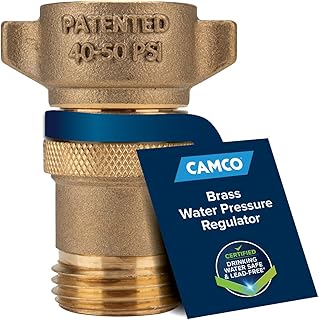 |
Camco Brass Marine/RV Water Pressure Regulator – Protects RV Kitchen Small Appliances, Plumbing & Hoses – Reduces RV Water Pressure to Safe & Consistent 40-50 PSI – Drinking Water Safe (40055) |
$12.24 | (23,560) | View on Amazon |
| #4 |  |
Hourleey Brass RV Water Pressure Regulator, Water Regulator for RV Camper with Filter Screen, Protector for Campers, Travel Trailers, RV Plumbing System, 40-50 PSI |
$9.99 | (1,585) | View on Amazon |