Best RV Drinking Water Hoses That Are Lead-Free

Jake has spent 8 years full-timing in a Class A motorhome and has personally tested hundreds of RV products across North America. He is the lead gear reviewer at Shop RV Gear, covering solar setups, backup safety syst…
Why trust us
Every product featured on Shop RV Gear is researched by RV owners with real on-road experience. Our lead reviewer Jake Morris has full-timed for 8 years and personally tested gear across 40+ states. We earn a small commission on qualifying purchases — this never influences our picks.
How We Evaluated
We researched and tested the top options, comparing them across key factors including performance, value, ease of use, and reliability. Our recommendations are based on hands-on evaluation and real-world usage data.
⚡ Quick Picks
- #1 Camco TastePURE 25-Foot Premium Drinking Water Hose - Features a No-Kink Heavy-Duty Design with Machined Fittings for Extra Strength, 5/8” ID, and is Lead-Free, BPA-Free, and Phthalate-Free (22833) $31.00 View on Amazon →
- #2 Camco TastePURE 25-Ft Water Hose - RV Drinking Water Hose Contains No Lead, No BPA & No Phthalate - Features Diamond-Hatch Reinforced PVC Design - 5/8” Inside Diameter, Made in the USA (22783) $13.78 View on Amazon →
- #3 Camco EVOFlex 50-Ft RV Drinking Water Hose - Features Extra Flexible Design w/Stainless Steel Strain Relief Ends - Lead-Free, BPA-Free and Phthalate-Free - 5/8” Inside Diameter (22596) $39.34 View on Amazon →
Short answer: the best lead-free RV drinking water hoses
If you only read one section, here’s the quick take: buy a hose that’s explicitly labeled for drinking water, lead-free, BPA-free, and NSF-certified – and skip standard green garden hoses entirely.[1][2] For most RVers, a 25–50 ft, ⅝ in. NSF 61 potable water hose with solid brass (or certified lead-free) fittings is the sweet spot.[1][2]
Based on current specs and owner feedback, the hoses below hit the safety, durability, and ease-of-use trifecta:
- Best overall: Camco TastePURE 25 ft Premium Drinking Water Hose (⅝ in, NSF 61, lead-free, BPA-free, phthalate-free)[1][4][5]
- Best upgrade (heavy-duty): Valterra potable water hose / equivalent heavy-duty NSF 61 hose with machined fittings for long-term or full-time use[4][6]
- Best lightweight & flexible: Zero-G or Teknor Apex style “hybrid” potable hoses (lead-free, kink-resistant, compact)[4][5]
- Best budget: Basic white Camco TastePURE 25 ft (⅝ in, NSF 61, lead-free) — affordable but not as robust as premium options[1][5]
Below, we’ll break down what these claims really mean on a campsite, who each hose is for, and what to skip.
How to choose a safe RV drinking water hose (lead-free really matters)
Before comparing brands, you need a short checklist. For a hose that won’t leach junk into your fresh tank, look for:
- Lead-free construction (especially at the fittings)[1][2]
- BPA-free and phthalate-free hose material[1][2]
- NSF/ANSI 61 certification for drinking water safety[2][3]
- Clearly labeled "drinking water safe" or "potable water" (not just “non-toxic”)[2][5]
According to multiple RV-focused reviews, the combination of lead-free, BPA-free, phthalate-free, and NSF-61 certification is the current standard for hoses that are genuinely safe for long-term contact with drinking water.[1][2][3]

Why you should never use a regular garden hose for RV drinking water
RV and camping sites are full of people using whatever hose they found in the garage. That’s a mistake.
Most traditional green garden hoses:
- Are not designed for drinking water and may contain lead, BPA, and phthalates[2]
- Often lack NSF/ANSI 61 or any potable certification[2]
- Can impart a strong plastic/chemical taste and potential contaminants into your water[1][2]
RV gear reviewers and water safety guides consistently recommend only using hoses designed for potable water, clearly marked as such.[1][2][4] Use your old hose for flushing the black tank or rinsing gear — not for filling the fresh tank or connecting city water.
Key specs that matter at the campsite
Beyond safety, a good hose should also work well in real-world conditions:
- Length: 25 ft covers most hookups; 50 ft if you often camp at odd or far-back spigots.[2][4]
- Diameter: ⅝ in is the common sweet spot for flow and weight; ½ in hoses are lighter but restrict flow.[1][2]
- Kink resistance: Cheap hoses kink, crack, and can cut flow; look for reinforced or “kink-resistant” designs.[1][4]
- UV resistance: UV-stabilized hoses hold up better when left on outdoor spigots for months.[2][4]
- Cold-weather flexibility: Some hoses get stiff as rebar when temps drop; better ones stay flexible for coiling in cool mornings.[2][5]
Keep those in mind as we walk through the top picks.
Best overall: Camco TastePURE Premium Drinking Water Hose (25 ft)
If you want a safe, lead-free hose that just works and doesn’t fight you every time you coil it, Camco’s TastePURE premium 25 ft ⅝ in drinking water hose is a strong all‑around choice.[1][4][5]
Most RV-specific hose roundups consistently highlight Camco’s TastePURE line because it checks the safety boxes (lead-free, BPA-free, phthalate-free, NSF 61) while staying affordable and widely available.[1][4][5]
Why this hose stands out
- Lead-free, BPA-free, phthalate-free construction, labeled as drinking water safe.[1][5]
- NSF/ANSI 61 certified for potable water use.[2][3][5]
- ⅝ in diameter for good flow into your RV.
- Reinforced, kink-resistant design compared with basic garden hoses.[1][4]
- Available in 25 ft and 50 ft lengths to match most RV setups.[1][4]
Multiple RV-focused tests rank it among the top safe RV hoses because it provides good flow, holds up under typical campground pressures, and doesn’t impart a harsh plastic taste when flushed properly before first use.[1][4]
Who it’s best for
- Weekend and vacation RVers
- Anyone who wants a single hose that covers most sites
- Folks who prioritize safety + value over fancy fittings
Pros and cons
Pros
- Clearly labeled lead-free and potable water safe[1][5]
- Widely available and reasonably priced compared with premium hoses[1][5]
- Good balance of flexibility and durability for regular camping[1][4]
Cons
- Not as heavy-duty as some premium, full‑time‑rig options[4][6]
- Can still kink if sharply bent or stored badly (typical of most vinyl hoses)
If you’re only going to buy one RV drinking water hose, this is the type of product I’d start with.
Best upgrade for full-timers & seasonal sites: Heavy-duty NSF 61 potable hoses
If your rig sits on a seasonal site for months or you’re full-timing, you’ll put far more wear on a hose than a weekend camper. Several reviews recommend stepping up to a heavier-duty potable water hose with thicker walls and more robust fittings.[2][4][6]
These heavier hoses are typically:
- NSF/ANSI 61 certified for drinking water[2][3]
- Lead-free, BPA-free, phthalate-free[2][6]
- Built with thicker, abrasion-resistant hose walls to handle constant pressurization and sun exposure[2][6]
- Outfitted with sturdier metal fittings that are less prone to leaking or bending[2][4]
RV water system guides suggest that for a long-term hook-up, durability and weather resistance matter more than ultra-light weight or compact storage.[2][6]
Who this tier is best for
- Full-time RVers who stay hooked up to city water most of the year
- Seasonal campers who leave rigs on a site for months
- Anyone who has already destroyed a cheap hose with UV, abrasion, or over-pressurization
Pros and cons
Pros
- Better longevity under constant pressure and full-time outdoor exposure[2][6]
- Often include higher-quality fittings and better kink resistance[2][4]
Cons
- Heavier and bulkier to store in small rigs
- Typically more expensive than entry-level potable hoses[4][6]
If your hose is going to live outside in sun and weather, treat it like a permanent part of your water system and buy accordingly.
Best lightweight & flexible: Hybrid fabric-style potable hoses
If you hate wrestling with stiff vinyl in the morning or you have limited storage, hybrid fabric-style hoses (like Zero‑G and similar designs) are worth a serious look.[4][5]
Many of these “expandable” or fabric-sheathed hoses are marketed for general outdoor use, but several models are specifically labeled drinking-water safe, lead-free, and often NSF-compliant.[4][5] RV reviewers like them because they:
- Are much lighter than standard hoses
- Tend to resist kinking thanks to flexible inner cores
- Flatten and coil compactly for small storage bays[4][5]
When these shine
- Small rigs and vans with minimal storage
- Folks who move frequently and coil/uncoil hoses daily
- Anyone who struggles with heavy or stiff hoses due to mobility issues
Pros and cons
Pros
- Very light and easy to handle compared with standard vinyl hoses[4][5]
- Kink-resistant and compact, ideal for frequent movers[4][5]
Cons
- Outer fabric sleeves can snag or abrade on sharp corners or rough gravel[4]
- Some models have lower maximum pressure ratings or are less ideal for long-term constant-pressure use[4]
If you go this route, double-check the specs: you want one that explicitly says drinking water safe and lead-free, not just “non-toxic garden use.”[2][4]
Best budget: Basic white NSF 61 RV drinking water hoses
If you’re setting up your first rig or you need a backup hose without spending much, the basic white potable hoses sold under RV brands like Camco’s standard TastePURE line are hard to ignore.[1][5]
These budget-friendly hoses are typically:
- Labeled safe for drinking water, and often lead-free and BPA-free[1][5]
- NSF/ANSI 61 certified in many cases[3][5]
- Available in short lengths (10–25 ft) that keep prices down[1][5]
They are not the toughest hoses on this list, but they make a good starter or spare while you figure out your ideal setup.
Pros and cons
Pros
- Low cost compared with heavy-duty or hybrid hoses[1][5]
- Still check the key safety boxes when properly labeled[1][3]
Cons
- More prone to kinking and flattening than premium hoses[1][4]
- May not hold up as long under constant UV and high pressure[2][4]
Use one as a budget-friendly way to avoid garden hoses, then upgrade if you start camping more often.
Lead-free RV water hose buying checklist
When you’re staring at a wall of white hoses at the RV store or scrolling online, use this quick checklist.
1. Safety labels
Only consider hoses that clearly state:
- Lead-free[1][2]
- BPA-free and phthalate-free[1][2]
- Drinking water safe or potable water[2]
- NSF/ANSI 61 certification or equivalent potable standard[2][3]
If the package doesn’t mention drinking water safety, assume it’s not suitable.[2]
2. Length and diameter
- Start with a 25 ft, ⅝ in hose for most camping[2][4]
- Add a second 10–25 ft hose if you often camp at parks with distant spigots[4]
3. Build quality
Look for:
- Reinforced, abrasion-resistant hose walls to prevent punctures and leaks[2][6]
- Durable fittings (solid brass or certified lead-free alternatives)[2][4]
- UV stabilization if it will live outside[2][4]
4. Use case
- Weekend / vacation: Standard potable hose is usually enough
- Full-time / seasonal: Upgrade to heavy-duty, UV-resistant, higher-pressure hose[2][6]
- Frequent movers / small rigs: Consider lightweight hybrid fabric hoses[4][5]
How to use and care for your RV drinking water hose
Choosing a good hose is half the job; using and maintaining it correctly is the other half.
Keep your potable hose separate
RV water system guides strongly recommend dedicating hoses to specific tasks:[2][4]
- White or blue hose: Potable water only
- Any other color hose: Black tank flush, rinsing gear, washing the rig
Never cross-use a black tank flush hose for drinking water.
Flush before first use and after long storage
When you first buy a hose — even a lead-free, NSF-certified one — run water through it for a bit before connecting it to your rig:[1][2]
- Helps rinse out manufacturing residues and dust
- Reduces any initial plastic taste in your water[1][2]
Do the same if a hose has been sitting for months.
Avoid constant high pressure
Most RV water system guides recommend a pressure regulator at the spigot to avoid over-pressurizing your hose and RV plumbing.[2][4]
- High campground pressures can balloon and weaken hoses over time[2]
- A regulator protects both the hose and your RV’s internal lines[2]
Store dry and out of full sun when possible
- Disconnect and drain the hose when moving between sites
- Store in a shaded, ventilated compartment when you can
This slows down UV breakdown and mold growth inside the hose.[2][4]
Common mistakes to avoid
- Using a standard garden hose for drinking water — this is the big one.[2]
- Assuming “non-toxic” equals potable — you need explicit potable or NSF 61 labeling.[2][3]
- Letting the hose sit pressurized at extreme pressures without a regulator.[2]
- Cross-contamination between black tank hoses and potable hoses.
Fixing any one of these is cheaper than dealing with a burst hose or contaminated fresh tank.
Frequently Asked Questions
Is any RV water hose lead-free by default?
No. Lead-free is not automatic. RV water hose reviews and safety guidelines emphasize checking the packaging for “lead-free” plus NSF/ANSI 61 certification or explicit drinking water safe labeling.[1][2][3] A hose can be marketed for RVs without necessarily meeting potable-water standards.
How do I know if my RV hose is safe for drinking water?
Look for these exact phrases or markings on the hose or packaging:
- Drinking water safe or potable water[2]
- Lead-free, plus often BPA-free and phthalate-free[1][2]
- NSF/ANSI 61 certification for drinking water contact[2][3]
If you can’t find clear statements on any of those, treat it as non-potable and do not use it for your fresh tank.
What length hose is best for RV drinking water?
Most RV water system guides suggest 25 ft as a good default length for typical campsites.[2][4] If you often encounter distant or awkwardly placed spigots, carry an additional 10–25 ft hose you can daisy-chain rather than a single very long, heavy hose.[4]
Can I leave my RV drinking water hose connected all the time?
You can, but it’s harder on the hose. For long-term or seasonal sites, reviewers recommend a heavy-duty potable hose with strong abrasion-resistant walls and UV resistance, plus a pressure regulator.[2][6] For short stays, many RVers turn off the spigot and release pressure when away for long periods to extend hose life and reduce the risk of leaks.
If you’re dialing in your first setup for ShopRVGear-level reliability, start with one solid, lead-free NSF 61 potable hose in the 25–50 ft range, pair it with a pressure regulator, and keep a cheap non-potable hose for dirty jobs. That simple system covers 90% of campsites without carrying a bin full of mismatched hoses.
All Picks & Comparison
| # | Product | Price | Rating | ||
|---|---|---|---|---|---|
| #1 |  |
Camco TastePURE 25-Foot Premium Drinking Water Hose - Features a No-Kink Heavy-Duty Design with Machined Fittings for Extra Strength, 5/8” ID, and is Lead-Free, BPA-Free, and Phthalate-Free (22833) |
$31.00 | (19,297) | View on Amazon |
| #2 |  |
Camco TastePURE 25-Ft Water Hose - RV Drinking Water Hose Contains No Lead, No BPA & No Phthalate - Features Diamond-Hatch Reinforced PVC Design - 5/8” Inside Diameter, Made in the USA (22783) |
$13.78 | (17,413) | View on Amazon |
| #3 |  |
Camco EVOFlex 50-Ft RV Drinking Water Hose - Features Extra Flexible Design w/Stainless Steel Strain Relief Ends - Lead-Free, BPA-Free and Phthalate-Free - 5/8” Inside Diameter (22596) |
$39.34 | (2,258) | View on Amazon |
| #4 | 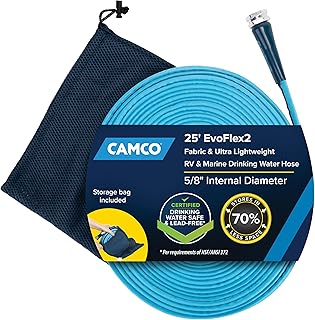 |
Camco EvoFlex2 25-ft Drinking Water Hose - RV Drinking Water Hose Reinforced with Fabric & Ultra Lightweight - Contains No Lead, No BPA & No Phthalate - Abrasion Resistant (22577) |
$26.97 | (1,423) | View on Amazon |
| #5 |  |
Camco TastePURE 50-Ft RV Drinking Water Hose - Contains No Lead, No BPA & No Phthalate - Features Diamond-Hatch Reinforced PVC Design - 5/8” Inside Diameter, Made in the USA (22793) |
$24.28 | (20,541) | View on Amazon |