
Best Portable Fire Pits for RV Campsites

Jake has spent 8 years full-timing in a Class A motorhome and has personally tested hundreds of RV products across North America. He is the lead gear reviewer at Shop RV Gear, covering solar setups, backup safety syst…
Why trust us
Every product featured on Shop RV Gear is researched by RV owners with real on-road experience. Our lead reviewer Jake Morris has full-timed for 8 years and personally tested gear across 40+ states. We earn a small commission on qualifying purchases — this never influences our picks.
How We Evaluated
We researched and tested the top options, comparing them across key factors including performance, value, ease of use, and reliability. Our recommendations are based on hands-on evaluation and real-world usage data.
⚡ Quick Picks
- #1 Outland Living Portable Propane Fire Pit, 19-inch, 58,000 BTU with Fire Pit Cover & Carry Kit, Smokeless Gas Firebowl | Perfect for Camping, Patio, Backyard, Tailgating, Deck, RV| Black 893 Deluxe $149.33 View on Amazon →
- #2 Flame King Smokeless Propane Fire Pit, 24-inch Portable Firebowl, 58K BTU with Self Igniter, Cover, & Carry Straps for RV, Camping, & Outdoor Living $148.60 View on Amazon →
- #3 Ciays Large Propane Fire Pit 19 Inch, Gas Fire Pit with Grill Grate, Folding Legs, Hose Hooks, Propane Tank Holder, Cover & Carry Strap, Portable Outdoor Fire Pit for Camping, 58,000 BTU $119.99 View on Amazon →
Short answer: the best portable fire pits for RV campsites
If you want one portable fire pit that works at most RV parks, is allowed under many fire bans, and doesn’t coat your rig in smoke, get a compact propane fire pit with a locking lid and long hose. According to Camping World, portable propane fire pits are popular with RVers because they light instantly, don’t throw sparks, and are often allowed when wood fires are banned.[9] For dry-camping and boondocking, add a smokeless wood-burning pit with folding legs so you can still burn real wood where it’s legal.
Below, we break down the best portable fire pits for RV campsites by use case (full hookups vs boondocking, strict parks vs relaxed boondocking spots), what to look for in BTUs and weight, and what to skip (cheap, shallow bowls that warp or blast heat straight up instead of out where you’re sitting).

Our top picks at a glance
- Best overall for most RVers: Mid‑size portable propane fire pit with locking lid and 50,000–60,000 BTU burner
- Best premium smokeless experience: Double‑wall stainless “smokeless” wood fire pit
- Best ultra‑portable / van and small‑rig pick: Pack-flat or collapsible steel fire pit
- Best budget RV fire pit: Basic steel propane pit from a reputable RV brand
- Best for larger groups: Large smokeless or high‑output propane pit (60,000+ BTU)
Note: Exact models, prices, and availability change quickly. Always confirm current specs and reviews before buying.
How to choose the best portable fire pit for RV campsites
1. Start with your typical camping style
Ask yourself:
- Do you mostly stay in RV parks and campgrounds with hookups, close neighbors, and fire rules?
- Or do you boondock on public land where wood is allowed and space is wide open?
According to the Camping World gear guide on portable propane fire pits, RVers like propane because it’s clean, controllable, and easy to shut off, which fits campground rules and quiet hours.[9]

If you mostly stay in RV parks:
- Prioritize propane: faster, cleaner, often allowed during “no wood” restrictions.[9]
- Look for a lid and carry handle so you’re not storing a dirty bowl of lava rock in your pass‑through.
- Make sure it has a long hose (approx. 10 ft) so the fire pit can sit away from the rig and propane source.
If you mostly boondock or camp on public land:
- Consider a smokeless wood fire pit for the classic campfire feel without choking smoke.
- Check local fire restrictions and whether wood-burning is allowed at all.[2]
- Choose a model with good airflow and ash containment so you don’t scorch the ground.[2]
2. Propane vs wood: which is best for RVers?
Portable propane fire pits have become especially popular with RVers.[6][9]
Propane fire pits – Pros & cons
Pros:[6][9]
- Very easy to light (igniter or lighter, no kindling).
- No sparks and fewer embers, reducing fire risk near rigs and in dry conditions.[9]
- Often allowed during wood fire bans, because the flame can be shut off instantly.[6][9]
- No wood storage, no ash cleanup, less smoke residue on awnings and fabrics.[6]
Cons:[6]
- You’re burning your propane, which hits your tank reserves.
- Flame pattern is less “campfire authentic” compared with real wood.
- Heat output can feel more directional and “jet-like” on some burners.
Wood fire pits – Pros & cons
Pros:[6]
- Classic campfire experience: crackling logs, natural flame.
- Wood can be cheaper or free depending on location.
- Smokeless models push heat out more evenly.
Cons:[2][6]
- Often banned during fire restrictions; check local rules.[2]
- More smoke, which can bother neighbors and stain your RV.
- Need to haul or collect wood, manage embers, and fully extinguish with water and stirring.[2]
Most RVers end up with propane as the primary fire pit and, if they love wood fires, a secondary smokeless pit for boondocking.
3. Key features that actually matter for RV use
Focus on these when you compare product pages and reviews:
- BTU rating (propane): 40,000–60,000 BTU is a useful range for RV campsite use; higher BTUs mean more heat but also more propane consumption.
- Weight & pack size: Check you can realistically lift and store it in basement compartments or a truck bed.
- Lid and carry case: A solid lid keeps lava rocks or ash contained in transit.
- Hose length and regulator: For propane, a longer hose gives you more freedom to position the pit safely away from the rig.
- Spark screens (wood): Help contain embers in traditional designs.
- Materials: Stainless and heavier‑gauge steel last longer and resist warping.
Camping World notes that portability and simple setup are critical for RVers, especially when you’re moving every few days.[9]
1. Best overall for most RVers: mid‑size propane fire pit
A mid‑size portable propane fire pit from a reputable RV brand is the most practical choice for the majority of RV campsites.[9]
These typically include:
- Around 40,000–60,000 BTU burner output
- Lava rocks or fire glass
- 10 ft propane hose and regulator
- Cover or lid for transport
Why this style works so well for RVers:[6][9]
- Frequently accepted at RV parks, especially where wood fires are limited to park rings.
- Often allowed during wood fire bans, because they are considered gas appliances rather than open fires.[6][9]
- Setup is fast: connect, crack the valve, light, and adjust the flame height.
- Cleanup is just turning a knob and letting it cool; no ashes to haul.
Pros
- Works in the widest range of campgrounds and under many fire restrictions.[6][9]
- Clean, controllable flame with no sparks or flying embers.
- Easy to store if you choose a model with compact footprint and lid.
Cons
- Dependent on propane supply and tank capacity.
- Flame pattern is more “gas ring” than classic wood campfire.
Who it’s best for:
- RVers who mostly stay in developed campgrounds, private RV parks, and resorts.
- Anyone who wants hassle-free fire without smoke and mess.
2. Best premium smokeless experience: double‑wall wood fire pit
“Smokeless” double‑wall wood fire pits use secondary combustion to reburn smoke, giving you a hot, efficient, low‑smoke fire.
Why RVers like this style:
- Much less smoke blowing in your face compared to an open ring, thanks to improved combustion.
- Very hot, even heat for cold nights; the double‑wall design concentrates heat.
- Great for boondocking or parks that allow wood fires and don’t mandate fixed rings.
Pros
- Real wood fire experience with dramatically reduced smoke.
- Typically durable stainless or heavy steel construction.
- Some models include cooking accessories (grates, stands, etc.).
Cons
- Heavier and bulkier than ultra‑portable fire pits.
- Still subject to wood fire bans and local restrictions.[2][6]
- Need to let ashes cool and dispose of them properly, following Leave No Trace principles.[2]
Who it’s best for:
- RVers who love traditional campfires and frequently camp where wood fires are legal.
- Those with enough storage space and payload for a heavier unit.
3. Best ultra‑portable: pack‑flat or collapsible fire pits
If you travel in a small Class B, camper van, or pop‑up, a pack‑flat or collapsible steel fire pit is worth a look. You’ll see these in van‑life gear reviews as portable, flat‑packing frames that hold wood or charcoal and fold down when not in use.[1]
Pros
- Extremely compact when folded; easy to tuck behind other gear.[1]
- Lightweight, often just a few pounds.
- Good for occasional wood fires in places where they’re allowed.
Cons
- Usually wood‑only; not propane.
- Less durable long‑term than heavy smokeless pits.
- Shallow designs can scatter ash and coals if not used carefully.
Who it’s best for:
- Van campers, small trailer owners, and anyone obsessing over weight and space.
- Minimalists who prefer a simple, occasional fire pit rather than a nightly one.
4. Best budget-friendly RV fire pit: basic steel propane bowl
If you’re not ready to invest in a premium setup, a basic steel propane fire bowl is still a big upgrade over no fire at all.
Common features:
- Simple, open steel bowl with burner ring
- Lava rocks
- Attached regulator and hose
Camping and RV blogs often list these as top entry‑level upgrades because they provide the benefits of propane (clean, controllable flame) without the price of premium pits.[9][10]
Pros
- Typically lower price than smokeless pits or high‑end propane fire tables.
- Easy to use; minimal assembly.
- Works in many RV parks that allow gas fire pits.
Cons
- Thinner steel can warp if abused or overheated.
- May lack a proper locking lid or carry case, making storage messy.
- Aesthetics are basic; more “utility bowl” than centerpiece.
Who it’s best for:
- New RVers wanting a simple, inexpensive way to get a campfire at parks.
- Weekend campers who only use a fire pit occasionally.
5. Best for larger groups: high‑output propane or large smokeless pits
If you regularly camp with friends and family, you’ll want something with substantial heat output.
High‑output propane pits (60,000+ BTU)
- Excellent for cold evenings and larger circles of chairs.
- Rapid, adjustable heat; just remember this also burns propane faster.
Large smokeless wood pits
- Bigger units spread intense heat over a wider radius.
- Good for boondocking gatherings when wood is plentiful and legal.
Pros
- Warms more people, making it the social center of camp.
- Works well in shoulder seasons and higher elevations.
Cons
- Larger, heavier, and more awkward to store.
- More fuel consumption (either wood or propane).
Who it’s best for:
- Larger families and groups.
- RV clubs, rally goers, or seasonal campers staying in one spot for weeks.
What to skip (from real-world RV use)
Based on common complaints from RV owners and accessory roundups:[7][9][10]
Skip or think twice about:
- Huge fixed fire bowls that don’t fit your storage: If it barely fits in your pass‑through at home, it’ll be a nightmare on the road.
- Ultra‑cheap thin steel pits: These tend to warp, rust quickly, and feel wobbly after a season.
- Complex multi‑piece contraptions: If setup is fiddly, you’ll stop using it after the first trip.
- Wood‑only pits if you mostly stay at strict parks: Many RV parks either prohibit open wood fires or require you to use their fixed rings only.[2][9]
You’re better off spending a bit more on a simple, robust propane fire pit that you’ll actually use every night.[6][9]
Safety and campground rules (don’t skip this section)
Follow campground and local fire regulations
Askew’s Landing RV Campground highlights how critical it is to follow local rules and use designated fire rings or pits whenever they’re provided.[2]
Key points:[2]
- Use designated fire rings or pits in developed campgrounds whenever possible.
- Know whether propane fire pits count as open fires or appliances under current restrictions.
- Educate yourself about any fire bans before you light anything, wood or propane.[2]
Safe setup and operation
- Place the fire pit on clear, flat ground, away from overhanging branches, awnings, and dry grass.[2]
- Keep it well away from your RV, propane tanks, and fuel containers.
- Never leave a fire—wood or propane—unattended.[2]
- Keep water, a shovel, or a fire extinguisher nearby.[2]
Extinguishing your fire properly
For wood fires:[2]
- Douse with water, stir the embers, and repeat until everything is cool to the touch.
- Scatter cold ashes if appropriate, or dispose of them per campground rules.
For propane fire pits:
- Turn the gas control knob off first.
- Then close the propane cylinder valve.
- Allow everything to cool completely before covering or moving it.
Practicing good fire etiquette helps protect campgrounds, reduces wildfire risk, and keeps RVers welcome in sensitive areas.[2][6]
Frequently Asked Questions
Do portable propane fire pits count as a campfire during fire bans?
It depends. Some jurisdictions treat propane fire pits as gas appliances, which may be allowed during restrictions that ban wood fires.[6][9] Others define any open flame as a campfire. You must check local regulations and campground rules each time you camp, and when in doubt, ask the host or ranger before you light up.[2]
How big of a portable fire pit do I need for RV camping?
For most RV campsites, a mid‑size propane pit in the 40,000–60,000 BTU range is plenty for a small group. If you regularly camp with more than 4–5 people or in colder shoulder seasons, consider higher BTU propane or a larger smokeless wood pit for more heat coverage.
Can I use my portable fire pit on a campsite’s picnic table or concrete pad?
Generally, no for tables, maybe for concrete, depending on the pit and rules. Most fire pits are intended for ground use, on a non‑combustible surface with plenty of clearance. Some parks allow fire pits on concrete pads if there’s no risk of scorching, while others require use within designated rings only.[2] Always follow the manufacturer’s instructions and campground policies.
Is a portable fire pit worth it if my RV campground already has fire rings?
Often yes, especially if you value quick, clean campfires and want an option during wood bans. A propane fire pit means you can have a fire without buying wood, without leaving ash, and without relying on an often‑smoky shared ring. Many RVers report that after switching to propane, they have more fires more often because it’s so easy to set up and shut down.[6][9]
If you’re unsure where to start, begin with a compact propane fire pit that fits in your storage and matches your propane setup. Use it for a season, then decide if you want to add a smokeless wood pit for boondocking. That combination covers almost every RV campsite you’ll roll into.
All Picks & Comparison
| # | Product | Price | Rating | ||
|---|---|---|---|---|---|
| #1 |  |
Outland Living Portable Propane Fire Pit, 19-inch, 58,000 BTU with Fire Pit Cover & Carry Kit, Smokeless Gas Firebowl | Perfect for Camping, Patio, Backyard, Tailgating, Deck, RV| Black 893 Deluxe |
$149.33 | (17,741) | View on Amazon |
| #2 | 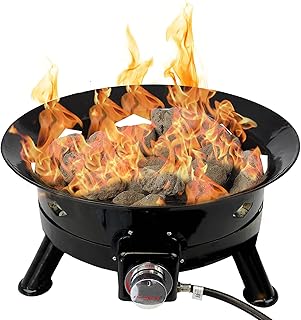 |
Flame King Smokeless Propane Fire Pit, 24-inch Portable Firebowl, 58K BTU with Self Igniter, Cover, & Carry Straps for RV, Camping, & Outdoor Living |
$148.60 | (1,183) | View on Amazon |
| #3 |  |
Ciays Large Propane Fire Pit 19 Inch, Gas Fire Pit with Grill Grate, Folding Legs, Hose Hooks, Propane Tank Holder, Cover & Carry Strap, Portable Outdoor Fire Pit for Camping, 58,000 BTU |
$119.99 | (336) | View on Amazon |
| #4 | 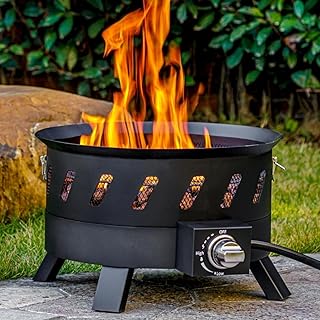 |
EcoNook 17.3 inch Portable Propane Fire Pits, Gas Fire Pit Bowl for Outside with Lid & Handle, Smokeless Gas Firebowl,Propane Firepit for Camping, Patio, Yard, Garden |
$94.79 | (452) | View on Amazon |
| #5 |  |
TURBRO 19 Inch Smokeless Fire Pit for Outdoor Wood Burning, Portable Stainless Steel Camping Stove with Stand, Removable Ash Pan, Waterproof Storage Bag, Unique Nested Design, Pluto R19-PG, Black |
$119.99 | (705) | View on Amazon |