
Best Outdoor RV Rugs for Patios and Campsites

Jake has spent 8 years full-timing in a Class A motorhome and has personally tested hundreds of RV products across North America. He is the lead gear reviewer at Shop RV Gear, covering solar setups, backup safety syst…
Why trust us
Every product featured on Shop RV Gear is researched by RV owners with real on-road experience. Our lead reviewer Jake Morris has full-timed for 8 years and personally tested gear across 40+ states. We earn a small commission on qualifying purchases — this never influences our picks.
How We Evaluated
We researched and tested the top options, comparing them across key factors including performance, value, ease of use, and reliability. Our recommendations are based on hands-on evaluation and real-world usage data.
⚡ Quick Picks
- #1 Stylish Camping Outdoor Patio / RV Camping Mat - Swirl (Black/White, 9-Feet x 12-Feet) $65.81 View on Amazon →
- #2 EEZ RV Products 9'x18' GW Heavy Duty Reversible/Durable Outdoor Patio/RVing Mats(9ft x18ft Grey) Come with Large Storage Bag & 6 Sets of Stakes and Washer $139.00 View on Amazon →
- #3 Stylish Camping SD8187 8-Feet x 18-Feet Graphic Swish RV Reversible Patio Mat, Brown/Tan $69.95 View on Amazon →
Short answer: the best outdoor RV rugs that actually hold up
If you camp more than a couple weekends a year, a breathable polypropylene RV mat is the sweet spot for durability, weight, and easy cleanup.[2][3] For most RVers, the Mountain Mat recycled plastic RV mats are the best overall choice: they’re UV-resistant, mold/mildew resistant, made from recycled plastics, light enough to carry one-handed, and clean up with a quick hose-down or sweep.[4] The CGEAR Sand-Free RV Mat is the premium pick if you camp on sand and hate grit in the rig, while budget woven polypropylene mats from brands like RVGUARD or generic camping mats work fine for occasional weekend trips if you accept a shorter lifespan.[3][4][5][9]
Below are the top picks, how to size them for your patio, and what actually matters in materials, edging, and weight once you’ve camped on them for a full season.

Best Outdoor RV Rugs for Patios and Campsites: Top Picks
1. Mountain Mat Recycled Plastic RV Mat — Best Overall
Why it’s first: Mountain Mat is one of the few RV mats that consistently survives multiple seasons without fraying, fading badly, or turning into a moldy mess. It hits the sweet spot of durability, breathability, eco-friendly recycled material, and easy cleaning, and actual RV users praise its light weight and longevity.[3][4]
Key features
- Recycled woven plastic (polypropylene) construction for outdoor use[4]
- UV, mold, and mildew resistant for long-term camping[4]
- Breathable weave so it does not smother grass completely[4]
- Lightweight for its size; easy to carry and fold[4]
- Cleans with hose, broom, or even a leaf blower[4]
- Multiple sizes to fit Class B vans up through large fifth wheels[3][4]
Real-world pricing (approximate, not guaranteed):

- Mid-size (~5×7 ft): often around the $80 range[4]
- Smaller mats (~3×6 or 4×6 ft): sometimes around $40[4]
- Large RV patio mats: reported around $179 for big “camper-size” mats[4]
Pros
- Very durable compared to cheap big‑box RV mats[3][4]
- Made from recycled plastic, better for eco-conscious buyers[4]
- Lightweight and packs down small for storage[4]
- Truly easy to clean — hose off or blow off sand and dirt[4]
- Designed specifically for camping and RV use[3]
Cons
- Costs more up front than the bargain‑bin mats[4]
- Woven plastic still feels “mat-like,” not like an indoor rug (normal for RV mats)[3]
- You still need to dry it before storage to avoid mildew smells
Best for: RVers who camp regularly (weekenders to seasonal) and want one mat that can last for years with proper care.
2. CGEAR Sand-Free RV Mat — Best for Sandy Campsites & Beach Camping
Why it’s worth it: If you camp near the beach, dunes, or dusty desert, the CGEAR Sand-Free RV Mat has a cult following among RVers. It uses a dual-layer weave that lets sand and fine dust fall through but not come back up, dramatically cutting how much grit ends up in your rig.[5]
Key features
- Unique dual-layer sand-free fabric technology designed to shed sand and fine dust[5]
- Lightweight and fast-drying vs heavy carpet-style mats[5]
- Designed specifically as an RV patio mat version[5]
- Easy to clean — shake, sweep, or hose off[5]
Pros
- Excellent for sandy sites — sand drops through instead of piling on top[5]
- Does not hold water like thick fabric mats; dries quickly[5]
- Lighter and less bulky than many traditional mats[5]
- Good traction underfoot for outdoor living areas
Cons
- Typically more expensive than standard polypropylene mats[5]
- Not as “plush” as indoor/outdoor carpeting if you want a softer feel
- Sand still accumulates underneath; you’ll lift it and sweep occasionally
Best for: Beach campers, coastal snowbirds, and anyone sick of sweeping sand out of the RV every day.
3. RVGUARD Outdoor RV Rug — Best Budget-Friendly Patio Mat
Why it makes the list: If you’re on a tight budget or just starting out, the RVGUARD outdoor RV rug offers the classic woven polypropylene camping mat formula at entry-level pricing. It’s a solid option for occasional trips, especially if you don’t expect it to last five seasons.[9]
Key features
- Woven polypropylene plastic mat designed for RV patios[2][3][9]
- Typically available in large sizes like 9×18 ft for full-length awning coverage[9]
- Reversible patterns with neutral camping-friendly designs[9]
- Usually includes a carrying bag and stakes or loops for tie-downs (varies by listing)[9]
Pros
- Affordable vs premium brands[9]
- Large sizes cover most RV patio areas in one piece[9]
- Lightweight and folds compactly for storage[9]
- Easy to hose off and dry[2]
Cons
- Edging and weave quality are typically less robust, so fraying is more likely over time[3]
- UV exposure can lead to fading and brittleness faster than higher-end mats[3]
- Not as eco-friendly as recycled options
Best for: Occasional campers and budget-conscious buyers who want a full-size patio mat without spending Mountain Mat or CGEAR money.
4. Generic Woven Polypropylene RV Patio Mats — Best for Occasional Use
You’ll see a lot of unbranded or house-branded woven polypropylene RV mats on big-box shelves and online marketplaces. RV owner discussions often note that these mats work fine for a season or two but are more likely to curl, fray, or tear at the edges than better-built options.[3][6]
Pros
- Lowest upfront price for a large patio mat[6]
- Many sizes and patterns, easy to find locally
- Light and reasonably easy to clean[2]
Cons
- Edge binding is often a weak point; loose stitching and exposed weave can lead to premature failure[3]
- Cheaper plastic can become stiff, brittle, and faded with sun exposure[3]
- Not all are breathable enough for grass-friendly use[2][3]
Best for: Campers who only go out a few weekends a year and are okay replacing their mat more often.
What to Look For in an Outdoor RV Rug
If you want a mat that actually survives a few years of hauling, folding, and bad weather, focus on these features, not just the pattern.
1. Material: Polypropylene is the Workhorse
Most RV-specific outdoor rugs are made from polypropylene, a synthetic plastic that’s tough, heat-resistant, and still breathable enough to keep grass alive underneath when woven appropriately.[2]
Look for:
- UV resistance: Helps prevent fading and brittleness from constant sun exposure.[3]
- Mold and mildew resistance: Essential if you camp in humid climates or store the mat in a basement or bay.[3][4]
- Breathable weave: Allows water and air through so you’re not killing grass or creating puddles.[2][3][4]
Thick, absorbent “outdoor carpet” may feel nice at first, but it soaks up rain, takes forever to dry, and can smell musty. Many long-term RVers move away from those for this reason.[2]
2. Durability and Edge Construction
The difference between a mat that dies in one season and one that lasts years is often in the edges and stitching.
- Look for 4-sided edging from thick fabric and straight, tight stitching.[3]
- You should not see the raw plastic weave poking out from the edge binding.[3]
- Reinforced corner loops or grommets are useful for staking the mat in wind.[3]
If the edge looks sloppy or you can pull at loose threads in the store, it probably won’t survive repeated folding and flapping winds.
3. Size: Match the Rug to Your RV Patio
Before you buy, measure:
- The length of your awning/mainslide area
- The width from RV sidewall to the furthest you want to step out
Typical useful sizes:
- Small (3×6 to 5×8 ft): Good for vans, small trailers, or as a landing pad at the door.
- Medium (6×9 to 8×12 ft): Good for most travel trailers and smaller fifth wheels.
- Large (9×18 ft and up): Covers nearly full awning length for longer rigs.[9]
If you move sites often, a slightly smaller, lighter mat is often more practical; a giant mat can be cumbersome to fold and store when wet.
4. Portability and Storage
RV storage is always tight. When comparing mats, check:
- Weight: Some mats are “unbelievably light” relative to their size, which matters when you’re solo carrying them around a campground.[4]
- Foldability: Mats designed for RVs typically fold into a compact square rather than a long roll, fitting better in basement compartments.[3]
- Carry bag: A simple bag protects the mat from snagging and keeps dirt contained.
5. Ease of Cleaning
Outdoor RV rugs see mud, food spills, pet hair, and sand. To keep your floor clean without a lot of work, look for mats that:
- Clean with a quick shake or sweep.[1][4]
- Can be rinsed with a hose and left to air dry.[1][4]
- Don’t hold water like thick carpet or non-breathable fabric.[2][5]
Mountain Mat and CGEAR mats, for example, are both praised for simple cleaning — either sweeping, blowing off debris, or hosing them down back at home.[4][5]
6. Grass-Friendliness and Campground Rules
Some parks and campgrounds dislike solid mats that kill grass. Breathable RV mats made of woven polypropylene are designed to reduce this issue by letting sun and air reach the turf.[2][3]
When in doubt:
- Choose a breathable woven mat, not solid vinyl or thick carpet.[2]
- Ask the campground about their rules for mats on grass before you roll it out.
How to Use and Care for Your RV Patio Rug
An outdoor rug is only as good as how you deploy and maintain it.
Setup Tips at the Campsite
- Pick a flat, dry area under your awning so the mat lies flat and drains well.[1]
- Sweep the ground first to avoid rocks and sharp debris that can wear the weave.
- Stake or clip corners in windy areas to stop the mat from flipping or creeping under your steps.[1][3]
- Keep the door side clear so it doesn’t interfere with step operation.
Daily Maintenance
- Shake or sweep the mat each day to keep grit from grinding into the weave.[1]
- If it gets wet, try to let it dry fully before packing it away to avoid mildew smells.[1]
End-of-Trip Cleaning and Storage
- At home, hose off the mat to remove dirt, sand, and spills.[1][4]
- Let it air dry completely in the sun or shade.[1]
- Roll or fold neatly along the original creases to avoid stressing the weave.[1]
- Store in a cool, dry compartment, not pressed against metal that may rust or sharp objects that could cut it.[1]
Follow these basics and a quality mat like Mountain Mat or CGEAR can easily outlive a run of cheaper big‑box rugs.[3][4][5]
What to Skip (Hard-Learned Lessons)
After a few seasons of trial and error, most experienced RVers now avoid:
- Heavy indoor/outdoor carpet remnants — they soak up rain, stay soggy, grow mildew, and weigh a ton when wet.[2]
- Ultra‑cheap mats with thin edging — the weave separates from the edge binding quickly and begins to fray.[3]
- Non-breathable tarps or solid vinyl directly on grass — they can kill grass and may be against campground rules.[2][3]
- Overly thick foam “comfort” tiles outside — they trap water, blow apart in wind, and collect dirt in seams.
A simple, breathable polypropylene RV mat with good edging beats all of these in real-world camping conditions.[2][3]
Frequently Asked Questions
How big should my outdoor RV rug be?
Pick a size that roughly matches your awning coverage and the space where you actually sit. For most travel trailers, something around 6×9 to 8×12 ft works well; larger fifth wheels often use 9×18 ft mats to cover nearly the full patio.[3][9] Make sure there’s clearance for steps and doors to swing without catching the rug.
Are RV rugs bad for grass at campsites?
Solid, non-breathable mats can damage grass and some parks ban them.[2] Woven polypropylene RV mats are designed to be breathable, letting air and some light reach the grass to reduce damage.[2][3] Always check campground rules and, if in doubt, limit how long you leave a mat on grass.
How do I clean an outdoor RV rug?
Most RV mats clean up with a shake or sweep for daily use, then a hose-down and air dry at the end of the trip.[1][4] Mats like Mountain Mat and CGEAR are specifically praised for easy cleaning: sand, dirt, and spills rinse off quickly and the mat dries fast.[4][5] Avoid harsh chemicals; mild soap and water are usually enough.
Can I use a regular outdoor rug from a home store instead of an RV mat?
You can, but many RVers report that standard home-store rugs are heavier, less breathable, and not sized well for RV patios.[6][7] They may soak up water, dry slowly, and be harder to store in tight RV compartments. An RV-specific, breathable polypropylene mat is usually a better fit for frequent camping.[2][3]
How long should a good RV patio mat last?
With proper care (drying before storage, not dragging it over rocks, and avoiding constant full-sun baking), a higher-quality mat like Mountain Mat or CGEAR can last several seasons of regular use.[3][4][5] Ultra-cheap mats often start fraying or fading noticeably after a season or two, especially with intense sun exposure.[3]
All Picks & Comparison
| # | Product | Price | Rating | ||
|---|---|---|---|---|---|
| #1 |  |
Stylish Camping Outdoor Patio / RV Camping Mat - Swirl (Black/White, 9-Feet x 12-Feet) |
$65.81 | (19,379) | View on Amazon |
| #2 | 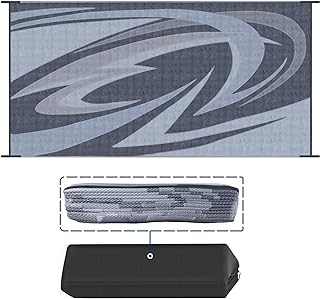 |
EEZ RV Products 9'x18' GW Heavy Duty Reversible/Durable Outdoor Patio/RVing Mats(9ft x18ft Grey) Come with Large Storage Bag & 6 Sets of Stakes and Washer |
$139.00 | (1,416) | View on Amazon |
| #3 | 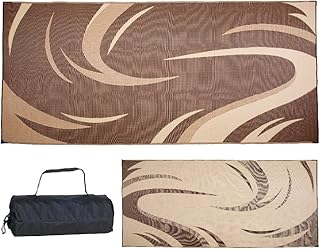 |
Stylish Camping SD8187 8-Feet x 18-Feet Graphic Swish RV Reversible Patio Mat, Brown/Tan |
$69.95 | (1,060) | View on Amazon |
| #4 |  |
SAND MINE Waterproof Outdoor Rug 5x8 ft, Plastic Reversible Rug, Modern Area Rug, Large Floor Mat for Outdoors, RV, Patio, Backyard, Deck, Picnic, Beach, Camping, Black Grey Lattice |
$28.79 | (11,237) | View on Amazon |