
Best RV Hitch Locks and Coupler Locks to Deter Theft

Jake has spent 8 years full-timing in a Class A motorhome and has personally tested hundreds of RV products across North America. He is the lead gear reviewer at Shop RV Gear, covering solar setups, backup safety syst…
Why trust us
Every product featured on Shop RV Gear is researched by RV owners with real on-road experience. Our lead reviewer Jake Morris has full-timed for 8 years and personally tested gear across 40+ states. We earn a small commission on qualifying purchases — this never influences our picks.
How We Evaluated
We researched and tested the top options, comparing them across key factors including performance, value, ease of use, and reliability. Our recommendations are based on hands-on evaluation and real-world usage data.
⚡ Quick Picks
- #1 Ft. Knox Locks Curt Style Trailer Coupler Lock for Bumper Pull Trailers with Trimax Puck Lock - Bolt Cutter & Crowbar Proof, Made in USA $218.00 View on Amazon →
- #2 Proven Industries Model 2516 Heavy-Duty Trailer Coupler Lock for 2 5/16 Couplers – RV & Trailer Anti-Theft Lock, Made in USA $275.00 View on Amazon →
- #3 Ft. Knox Locks Round Tube Gooseneck Trailer Coupler Lock with Trimax Puck Lock, Heavy Duty Steel Hitch Locks, Fits Bulldog BX1, Bolt Cutter and Crowbar Proof, Made in USA $248.00 View on Amazon →
Short answer: the RV hitch locks that actually deter theft
If you only skim one part of this guide, here’s the bottom line: no single hitch or coupler lock will stop a determined thief with tools and time—but the right locks, used together, make your RV a much harder and slower target, which is usually enough for thieves to move on.[6][4]
From recent testing and user reviews, a layered setup works best: a puck-style coupler lock that fully encloses the latch, a solid receiver hitch lock, and a visible coupler or wheel immobilizer for when the trailer is parked long term.[6][9] You want hardened steel, pick-resistant cores, and designs that can’t be popped off with a pry bar or by simply removing a pin.
Below I’ll walk through the best RV hitch and coupler locks right now, what they’re actually like to use at a campground or storage lot, and which ones to skip because they look secure but fail fast in real-world attacks.
How to choose the right RV hitch and coupler locks
Before specific products, it helps to know what actually matters and what’s just marketing fluff.
Key types of RV hitch security
- Coupler locks (while unhitched) – Lock over or into the coupler on your trailer’s tongue so it can’t be dropped onto a ball and towed away.[6][9]
- Receiver hitch locks (while hitched) – Replace the hitch pin that holds the ball mount or weight-distribution shank into your tow vehicle’s receiver.[6]
- Latch/door-style coupler locks – Clamp or cage the latch itself so it cannot be opened, even if someone has your key for the main coupler.[9]
- Wheel/axle immobilizers – Additional layer (like wheel boots or X‑chocks with locks) to physically stop rolling.[6]
What actually matters
1. Material and build

- Look for hardened steel, not pot metal or thin stamped steel that can be smashed or pried open.[4][9]
- Avoid cheap zinc castings and plastic components on the critical parts of the lock body.[9]
2. Design and coverage
- The more of the coupler is physically enclosed (puck or box style), the harder it is to attack with a pry bar or hammer.[6][9]
- Simple “lollipop” ball-only styles are quick and cheap but can sometimes be defeated by chain/strap methods or by slipping on a smaller ball.[4]
3. Lock core quality
- Prefer disc-detainer or higher-security cores and at least some pick/drill resistance, especially on premium locks.[9]
- Cheap padlock-style cores can be picked or raked quickly by someone who knows what they’re doing.[4]
4. Weather resistance & ease of use
- Look for covered keyways, stainless or coated parts, and keys that still turn easily after rain, road salt, and storage.[9]
- If the lock is a pain (tight fit, awkward key angle), you’ll be tempted not to use it every time.
5. Fitment
- Match the lock to your coupler size: common travel trailer couplers are 2 in or 2‑5/16 in balls, and some locks only work for a sub‑set of sizes.[4][9]
- For receiver locks, match the pin diameter: 5/8 in for most Class III–V, 1/2 in for Class I–II.[6]
Our top picks at a glance
Based on recent reviews, owner feedback, and design, here’s how the main contenders shake out:[4][9][1]
- Best overall RV coupler lock: Proven Industries Model 2178/2516 (puck-style, heavy-duty)
- Best budget coupler lock: Reese Towpower Universal Coupler Lock
- Best receiver hitch lock for travel days: Master Lock 2866DAT Swivel Head Receiver Lock
- Best integrated coupler + latch protection: Ft. Knox Lock for A‑Frame couplers
- Best visible deterrent for storage: Trimax UMAX100 Universal Coupler Lock
- Good upgrade pick with strong value: AMPLock U‑BR2516 (for 2‑5/16 in couplers)
Below I’ll break down where each one works best and what to watch out for.
1. Best overall RV coupler lock: Proven Industries (Model 2178/2516 series)
If you want the closest thing to “I’m making this trailer an absolute pain to steal,” Proven Industries coupler locks are the current benchmark.[9]
These are heavy, box-style locks that completely cage your trailer coupler and use a puck lock that is difficult to access with bolt cutters or pry bars.[9] Different models fit different couplers (A‑frame, straight tongue, etc.), but the concept is the same: the coupler sits inside a thick steel shell, then a puck lock secures it from below.
Best for: Long‑term storage, higher‑crime areas, owners willing to deal with extra weight and cost for maximum deterrence.
Pros
- Full enclosure design makes it very hard to attack with common hand tools.[9]
- Uses a high-security puck lock; shackle is not exposed to bolt cutters.[9]
- Made from heavy‑gauge steel with quality welding and coatings.[9]
- Model‑specific fits are tight, so there’s little wiggle room for prying.[9]
- Strong owner feedback for resisting real‑world theft attempts.[9]
Cons
- Much heavier and bulkier than budget locks, not something you toss in a small front storage bin.[9]
- More expensive than universal coupler locks (you’re paying for mass and security).
- You must match the model to your specific coupler, which takes a minute to confirm.
Skip it if: You only need a light deterrent for short grocery stops with the trailer in sight. This is overkill for that use case; choose a lighter, quicker lock instead.
2. Best budget coupler lock: Reese Towpower Universal Coupler Lock
For basic deterrence on a normal‑value travel trailer in a campground or driveway, the Reese Towpower Universal Coupler Lock is a solid budget pick.[1][9]
It uses a U‑shaped shackle over the top of the coupler and a ball insert that sits where the hitch ball would go.[9] It’s widely available, inexpensive, and fits most common ball sizes.
Best for: Everyday use where you want a clear deterrent but don’t need the weight or cost of a full box‑style lock.
Pros
- Affordable and widely available online and in big‑box stores.[1][9]
- Universal fit for common 1‑7/8 in, 2 in, and 2‑5/16 in ball couplers.[9]
- Quick to install and remove—takes seconds at a campsite.[9]
- Highly visible, which helps deter casual thieves.[4]
Cons
- As with most “universal” clamp locks, determined thieves can sometimes pry or beat them off with heavy tools.[4]
- Lock core is basic; not a high‑security cylinder.[9]
- Some reports of weather-related sticking if left on for long periods without lubrication.[9]
Skip it if: Your trailer lives in an unsecured storage lot or high‑theft area. In that case, move up to Proven Industries or a similar enclosed design.
3. Best receiver hitch lock: Master Lock 2866DAT Swivel Head
Many RVers focus only on coupler locks and forget the weak link: the receiver pin that holds your ball mount or weight-distribution shank to the tow vehicle.
The Master Lock 2866DAT Swivel Head Receiver Lock is a popular, well‑reviewed choice for securing the ball mount while still being quick to use on travel days.[1][9]
Best for: Locking your ball mount or weight‑distribution hitch to the tow vehicle on travel days, preventing quick grab‑and‑go theft of your expensive hitch hardware.[6]
Pros
- Swivel head design makes it easier to access and turn the key under the bumper.[9]
- Fits common 2 in and 2‑1/2 in receivers with 5/8 in pin diameter (verify your class rating).[9]
- Covered keyway for better weather resistance.[9]
- Reasonable price compared with premium anti‑theft pins.[9]
Cons
- Not as heavy‑duty as some specialty receiver locks.[4]
- Still a single shear pin—very determined thieves with large tools could eventually defeat it.
- Like most receiver locks, it doesn’t stop someone from towing your trailer if the coupler is unlocked; it only protects the hitch hardware.
Skip it if: You leave your hitch hardware off the truck when not in use. In that case, your money is better spent on a stronger coupler lock.
4. Best coupler + latch coverage: Ft. Knox Lock
The Ft. Knox Lock system is a heavy‑duty A‑frame coupler lock that uses a puck lock and thick steel cage to protect both the coupler and latch area.[1]
RV owners who park in unsecured storage lots or boondock near cities often upgrade to this style because it is very hard to access with prying tools and hides the keyway behind the steel body.[1]
Best for: A‑frame travel trailers and utility trailers where you want maximum coverage over the coupler and latch at the same time.
Pros
- Thick, welded steel body that wraps around the A‑frame coupler area.[1]
- Uses a hardened puck lock with no exposed shackle, similar to high‑security warehouse locks.[1]
- Harder to attack than open-shackle padlock or U‑bar styles.[1]
- Strong word‑of‑mouth among full‑timers and those storing trailers off‑site.[1]
Cons
- Heavy and bulky; not something you casually stash in a small compartment.
- Must be matched to the exact A‑frame coupler style for a tight fit.
- More expensive than typical "universal" locks.
Skip it if: You have a straight-tongue or surge-brake style coupler that’s not compatible, or you want a compact lock to carry in your truck at all times.
5. Best visible deterrent for storage: Trimax UMAX100 Universal Coupler Lock
The Trimax UMAX100 is a widely recommended universal coupler lock that combines a bright, highly visible housing with an internal ball insert.[4][9]
It’s not in the same league as a Proven Industries cage, but it offers better build quality than many budget universals and is easy to use.
Best for: Driveway and campground use where you want a high‑visibility deterrent that still offers decent resistance to casual tampering.[4][9]
Pros
- Universal design works with most 1‑7/8 in, 2 in, and 2‑5/16 in couplers.[9]
- Highly visible and looks substantial, which matters for deterrence.[4]
- Better fit and finishing than many low-cost universal locks.[9]
- Simple, tool‑free operation—slide on, turn key, done.[9]
Cons
- Still relies on a U‑bar and ball insert, which are more vulnerable than full cages to heavy prying.[4]
- Bulkier than bare-bones budget locks.
- Some users report lock core stiffness in cold or salty environments if not maintained.[9]
Skip it if: You routinely leave your trailer in remote storage or truly high‑risk areas; step up to a full enclosure lock instead.
6. Strong value upgrade: AMPLock U‑BR2516 (for 2‑5/16 in)
The AMPLock U‑BR2516 is a higher‑end cast and machined lock made specifically for 2‑5/16 in ball couplers.[9]
It uses robust materials and a proprietary lock core that is harder to pick than cheaper alternatives, and it clamps around the front of the coupler to reduce pry points.[9]
Best for: Owners with 2‑5/16 in couplers who want meaningful security without jumping all the way to the cost and weight of a Proven cage.
Pros
- Robust construction with solid cast components and tight tolerances.[9]
- Custom fit for 2‑5/16 in couplers minimizes wobble and lever points.[9]
- Better-than-average lock core and keying.[9]
- More compact than large box-style locks while still providing solid protection.[9]
Cons
- Not truly universal; only for 2‑5/16 in ball couplers.[9]
- More expensive than generic universal locks.[9]
- Still not as all-encompassing as a full cage design.
Skip it if: You have smaller ball sizes or a very unusual coupler shape—it may not fit correctly.
What to skip (and why)
Some products look secure in photos, but real‑world testing and owner reports raise red flags.[4][9]
You don’t need specific brand names here—just watch for these patterns:
Thin, stamped U‑bar coupler locks
- Often underpriced and made from thin metal you can bend or shear with a big pry bar or sledge.[4]
- Frequently use basic wafer locks that can be opened quickly with simple tools.[9]
Generic, unbranded hitch pins
- May use unhardened steel; a good hack saw or bolt cutters can work them over.[4]
- Unknown corrosion resistance and no track record of how they hold up.
Plastic-heavy “novelty” locks
- Anything with major visible plastic parts near the shackle or body is usually for appearance, not security.[9]
When in doubt, look for established brands that are mentioned across multiple RV/security reviews, and check user photos and reviews for evidence of weight, fit, and real‑world attack resistance.[4][9]
How to combine locks for real-world theft deterrence
The best strategy is layers, not one “magic” lock.[6][4]
Here’s a practical setup that works well for most RVers:
On travel days
- Use a receiver hitch lock (like the Master Lock 2866DAT) on the tow vehicle.[6]
- Consider a small latch lock or pin lock to keep the coupler latch shut even if someone pulls your main coupler lock at a fuel stop.[9]
At campgrounds
- Whenever you unhook, use a universal or enclosed coupler lock immediately (Reese, Trimax, AMPLock, or Proven).[4][9]
- If you’re in a sketchy area, add a wheel immobilizer or locked X‑chock for a second layer.[6]
Long‑term storage or high‑risk areas
- Use a heavy enclosure lock like Proven Industries or Ft. Knox on the coupler.[1][9]
- Add a wheel boot or locked chock on at least one axle.[6]
- Where possible, park with the tongue difficult to access (e.g., close to a wall, tree, or another vehicle).[6]
Remember: your goal is to make your trailer louder, slower, and more annoying to steal than the one parked next to it.
Installation and use tips from the road
These locks are simple, but a few habits make them much more effective:
- Test fit at home first. Make sure your new coupler lock fits snugly, doesn’t slip off at odd angles, and you understand how it seats.[9]
- Lube the keyway. A quick shot of graphite or dry lube now and then keeps the cylinder smooth and reduces the risk of snapping a key in the lock.[9]
- Key management. Keep at least two spare keys, one hidden in the truck and one at home. Avoid one‑key combinations that leave you stranded if that key breaks.
- Lock every time you unhook. Thieves target the path of least resistance. If your trailer is the “always locked” one, you’re already ahead.
- Record your lock brand and model. If the lock ever jams or is damaged in a theft attempt, it’s much easier to get replacement parts or prove value for insurance.
Frequently Asked Questions
Do RV hitch locks actually prevent theft, or just slow it down?
In practice, they mostly slow theft down and increase the risk for the thief, which is often enough to make them move on to an easier target.[6][4] Even the best lock can be defeated with time, noise, and big tools—your goal is to make that process as painful as possible.
What size coupler lock do I need for my travel trailer?
Most travel trailers use 2 in or 2‑5/16 in ball couplers, but there is variation.[4][9] Check the stamp on your coupler (usually on top or the side) or your trailer documentation, then choose a lock that explicitly lists your ball size and coupler style (A‑frame vs straight tongue).
Can I tow my RV with the coupler lock still on for short moves?
No. Never tow with a coupler lock installed. These locks are designed to block ball insertion or coupler movement; towing with one in place can damage the lock, the coupler, or cause an unsafe hitch connection.
Is a hitch lock enough, or do I need wheel locks too?
For most situations, a quality coupler lock plus a receiver hitch lock is a solid baseline.[6] If you store your RV long term, live in a high‑theft area, or have an especially valuable rig, adding wheel immobilizers or boots is a smart second layer.
Are keyed-alike systems worth it for RV locks?
Keyed-alike sets make life easier—you can often get coupler locks, receiver locks, and sometimes latch locks on one key system.[9] Just remember that convenience is the trade-off: if that key is lost or compromised, all your locks are too, so keep spares and store them carefully.
All Picks & Comparison
| # | Product | Price | Rating | ||
|---|---|---|---|---|---|
| #1 |  |
Ft. Knox Locks Curt Style Trailer Coupler Lock for Bumper Pull Trailers with Trimax Puck Lock - Bolt Cutter & Crowbar Proof, Made in USA |
$218.00 | (94) | View on Amazon |
| #2 |  |
Proven Industries Model 2516 Heavy-Duty Trailer Coupler Lock for 2 5/16 Couplers – RV & Trailer Anti-Theft Lock, Made in USA |
$275.00 | (1,743) | View on Amazon |
| #3 | 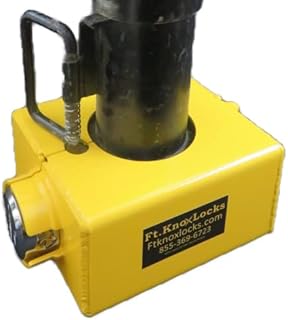 |
Ft. Knox Locks Round Tube Gooseneck Trailer Coupler Lock with Trimax Puck Lock, Heavy Duty Steel Hitch Locks, Fits Bulldog BX1, Bolt Cutter and Crowbar Proof, Made in USA |
$248.00 | (177) | View on Amazon |
| #4 |  |
Ft. Knox Locks Trailer Channel Coupler Lock with Trimax Puck Lock - Bolt Cutter & Crowbar Proof, Made in USA |
$168.00 | (11) | View on Amazon |
| #5 |  |
Demco 2-5/16" Adjustable Coupler Lock (LCS002 Demco) – Custom Fit for Dump and Equipment Trailers with C-Channel Mounts. (Includes Trimax Puck Lock) |
$239.00 | (30) | View on Amazon |