
Best RV Hitch Ball Mounts and Receiver Accessories

Jake has spent 8 years full-timing in a Class A motorhome and has personally tested hundreds of RV products across North America. He is the lead gear reviewer at Shop RV Gear, covering solar setups, backup safety syst…
Why trust us
Every product featured on Shop RV Gear is researched by RV owners with real on-road experience. Our lead reviewer Jake Morris has full-timed for 8 years and personally tested gear across 40+ states. We earn a small commission on qualifying purchases — this never influences our picks.
How We Evaluated
We researched and tested the top options, comparing them across key factors including performance, value, ease of use, and reliability. Our recommendations are based on hands-on evaluation and real-world usage data.
⚡ Quick Picks
- #1 CURT 17063 MV Round Bar Weight Distribution Hitch with Sway Control, Up to 14,000 lbs., 2-Inch Shank, 2-5/16-Inch Ball $359.28 View on Amazon →
- #2 Orion Motor Tech Trailer Hitch Ball Mount, Adjustable Tow Hitch for 2" Receiver with 2" Ball 9-1/2" Drop 8-1/4" Rise 8000 lb. Capacity, Heavy-Duty Drop Hitch with 3 Locking Hitch Pins for Truck Boat $56.99 View on Amazon →
- #3 CURT 45935 Adjustable Trailer Hitch Ball Mount with Dual Ball, 2" Shank, Up to 15,000 lbs $203.77 View on Amazon →
Short answer: the best RV hitch ball mounts & receiver add‑ons
If you tow a travel trailer or small fifth-wheel with a bumper-pull, your ball mount and receiver accessories are the critical link between your RV and your tow vehicle.[1][2] The best setup for most RVers is a quality 2" or 2.5" steel ball mount, matched to your trailer’s coupler size and weight, with proper drop/rise and a few core accessories: locking hitch pin, weight distribution/sway control (for heavier travel trailers), and basic protection like a hitch cover and ball cover.[1][2][7]
In this guide, I’ll walk through what actually matters when you’re towing, then call out specific ball mounts and receiver accessories that consistently perform well in real-world RV use. We’ll start with the best all‑around pick, then narrow down to use‑cases: adjustable vs fixed, heavy‑duty, off‑road, and budget. Finally, we’ll cover the hitch accessories that are worth your money—and a few you can skip.[1][2][7][8]

How RV ball mounts & receiver accessories work (in plain English)
Before you buy anything, it helps to understand what’s doing what.
Core hitch components (for a standard bumper‑pull travel trailer):
- Receiver hitch – The frame‑mounted hitch on your tow vehicle (2" or 2.5" opening is most common).[1][2]
- Ball mount (drawbar) – Slides into the receiver and provides the platform for the ball.[1][2]
- Hitch ball – The round ball that fits into the trailer’s coupler. Must match coupler size and be rated for the trailer’s weight.[4][5]
- Hitch pin & clip or lock – Secures the ball mount in the receiver.[1][2]
- Trailer coupler – The clamp on the front of your trailer that locks onto the ball.[1][4]
- Safety chains, wiring, and brakes – Backup connection and control systems so the trailer behaves if something goes wrong.[1]
A ball mount is just a shank (the part that slides into the receiver) and a platform for the ball.[2] On adjustable mounts, that platform can move up and down to dial in your trailer height.[5]

What matters in real use:
- Receiver size – 2" is common on half‑tons; 2.5" and 3" on heavy‑duty trucks.
- Ball size – Most travel trailers are 2 5/16"; small cargo/utility trailers may be 2" or 1 7/8".[4]
- Weight ratings – Every component (receiver, ball mount, ball, coupler) has a max GTW (gross trailer weight) and tongue weight rating; you must stay under the lowest‑rated part.[4]
- Drop or rise – The amount the ball mount needs to go up or down so the trailer tows level.[5]
If your trailer isn’t level or you mismatch ball sizes, you’re asking for sway, bad braking, and accelerated wear.[4][5]
How to choose the right RV hitch ball mount
Use this as a quick checklist before we talk specific products.
Confirm receiver size
- Most half‑ton trucks and SUVs: 2" receiver.
- Many 3/4‑ton and 1‑ton trucks: 2.5" (sometimes with a reducer sleeve for 2").
Match ball size to coupler
- Check the stamping on the coupler – it will be marked 1 7/8", 2", or 2 5/16".[4]
- Your hitch ball must match that size exactly and be rated for at least your loaded trailer weight.[4]
Calculate needed drop or rise
- Park tow vehicle and trailer on level ground.
- Measure from the ground to the inside top of the hitch receiver.
- Measure from the ground to the bottom of the trailer coupler (when level).
- Drop = receiver height – coupler height (if the receiver is higher).
- Rise is the opposite.
Check weight ratings
- You need:
- GTW rating ≥ your trailer’s loaded weight.
- Tongue weight rating ≥ 10–15% of GTW (typical travel trailer tongue weight).[4]
- Always go by the lowest‑rated component in the system.[4]
- You need:
Decide between fixed vs adjustable
- Fixed ball mount – Simple, cheap, strong. Great if you tow one trailer at one height.
- Adjustable ball mount – More expensive but easier if you tow multiple trailers or may change tow vehicles/trailers.[5]
Decide if you need weight distribution & sway control
- For longer or heavier travel trailers (especially behind half‑tons and SUVs), a weight‑distribution hitch with sway control can dramatically improve stability and braking.[6][7]
Best overall RV hitch ball mount (for most travel trailers)
1. CURT steel ball mount with 2 5/16" ball (fixed) — best for most RVers
For most RV owners towing a single travel trailer, a fixed CURT steel ball mount with a pre‑torqued 2 5/16" ball is the most practical, bomb‑proof choice.[2]
Why it works in the real world:
- CURT is one of the major OEM‑level towing brands, with clear, conservative ratings.[2]
- Their standard 2"‑shank ball mounts cover the common 4"–6" drop range RVers need.[2]
- Pre‑torqued kits with an installed 2 5/16" ball remove the most commonly botched step: under‑torqued hitch balls.
Pros
- Strong, one‑piece steel shank with thick ball platform.[2]
- Lots of drop/rise and weight rating options for common half‑ton tow setups.
- Widely available, easy to replace or match.
- Simple, no moving parts; less to rattle or loosen.
- Often available in corrosion‑resistant finishes (powder‑coat, chrome‑plated ball).
Cons
- Not height‑adjustable; you must pick the right drop.
- If you switch trailers often, you may need more than one.
Who it’s for: You tow one main travel trailer, want something simple and robust, and don’t plan to constantly swap trailers or vehicles.
Best adjustable ball mounts for RVs
If you tow different trailers (or you just don’t want to recalc drop every time you change vehicles), an adjustable ball mount makes life much easier.[5]
2. Adjustable steel drop ball mount — best for multi‑trailer setups
Adjustable steel ball mounts let you raise/lower the ball platform to keep any trailer level, and often include both 2" and 2 5/16" balls on a flip‑side setup.[5]
Pros
- One mount covers different trailer heights and coupler sizes.[5]
- Great if you tow an RV plus boat, utility, or car hauler.
- Steel construction tends to be more forgiving for rough roads.
Cons
- Heavier and bulkier than a fixed ball mount.
- More moving parts, bolts, and pins to inspect.
Who it’s for: RVers with more than one trailer or those who frequently change tow rigs and don’t want a drawer full of fixed‑drop ball mounts.
Heavy‑duty & high‑capacity options
If you’re towing close to the limits of a three‑quarter‑ton or one‑ton truck, step up to a 2.5" or 3" shank ball mount with appropriately high GTW ratings.[2]
3. Heavy‑duty 2.5" shank ball mount — for 3/4‑ton and 1‑ton trucks
Heavy‑duty ball mounts use thicker steel and longer shanks to handle higher tongue weights and longer wheelbases.
Pros
- Higher GTW/tongue ratings to match HD receivers.[2]
- Less flex and play under heavy load.
- Often compatible with reducer sleeves if you also tow with a 2" receiver.
Cons
- Heavier and more expensive than standard 2" units.
- Overkill for most half‑ton/SUV tow setups.
Who it’s for: Large travel trailers, heavy toy haulers, or frequent towing near the upper limits of your HD truck.
Off‑road & high‑articulation options
If you drag a small RV or overland trailer off‑pavement, look at articulating hitches and off‑road‑style mounts designed for extreme angles.
4. Off‑road ball mounts & articulating couplers
Off‑road setups often replace or augment the traditional ball/coupler with articulating heads, but you still use a stout receiver and shank.[6]
Pros
- Better articulation on washboard, ruts, and uneven trails.
- Reduced risk of binding at sharp dips and crests.
Cons
- More specialized; not needed for typical campground use.
- Some systems are not compatible with weight‑distribution hitches.
Who it’s for: Overlanders or boondockers who routinely tow on rough, uneven terrain.
Must‑have receiver accessories for RV towing
Once you’ve picked a solid ball mount, round out your setup with a few receiver accessories that materially improve safety and usability.
5. Locking hitch pin
A locking hitch pin replaces the basic pin/clip and stops your ball mount from walking off in a campground parking lot.[1][7]
Pros
- Prevents theft of your ball mount and sometimes the trailer itself.
- Still functions as your primary retention pin.
Cons
- More to maintain; lock cylinders don’t like road salt.
Tip: Stick to well‑reviewed, name‑brand locks and keep the key in your glovebox, not a random toolbox.
6. Hitch receiver cover & ball cover
A hitch receiver cover plugs the empty receiver to keep mud, ice, and rust at bay.[7][8]
A ball cover keeps grease off your pants and sand off the ball when not in use.[3]
Pros
- Helps prevent corrosion of the receiver tube.[7]
- Keeps grit off the ball, which reduces wear in the coupler.
Cons
- Easy to misplace; they come off quickly.
7. Trailer wiring adapter & mounting bracket
If you bounce between tow vehicles or trailers, you may need a 7‑way to 4‑flat adapter or vice versa.[7][8]
A fixed mounting bracket for the trailer connector keeps the plug secure and out of harm’s way.[7]
Pros
- Guarantees your lights and brakes work with different trailers.[7]
- Reduces strain on the wiring.
Cons
- Another small part to keep track of.
8. Weight‑distribution hitch with sway control (for heavier travel trailers)
For many travel trailers, the biggest single towing upgrade after a good ball mount is a weight‑distribution (WD) hitch with sway control.[6][7]
What it does:[6][7]
- Distributes tongue weight more evenly across all tow‑vehicle axles.
- Reduces front‑end lightness and poor steering feel.
- Provides built‑in sway control (friction bars or integrated systems).
Pros
- Noticeably better stability in crosswinds and when passing trucks.[6][7]
- Helps braking performance and steering on half‑tons and SUVs.
Cons
- More expensive and more complex to set up.
- Heavier to install/remove when not needed.
Who it’s for: Most RVers towing a longer or heavier bumper‑pull travel trailer, especially with lighter‑duty tow vehicles.[6][7]
9. Friction sway control bar (add‑on)
Independent friction‑style sway control bars bolt to the trailer frame and hook up to a small ball on the ball mount assembly.[6]
Pros
- Simple, relatively inexpensive way to add sway resistance.[6]
- Can be added to some existing weight‑distribution setups.
Cons
- Must be disconnected for tight maneuvers like backing into steep or angled sites.[6]
- Not as seamless as fully integrated sway control.
Installation & setup tips from the field
These are the practical details that matter once you’re in the driveway with tools out.
Proper torque on the hitch ball
A loosely installed ball is one of the most common failure points.
- Always follow the ball manufacturer’s torque spec (often well over 200 ft‑lb for large balls).
- Use a quality torque wrench that goes high enough, or have a shop torque it.
- Re‑check torque after your first few trips.
Pre‑installed/torqued ball‑mount kits help avoid this step entirely.
Greasing the hitch ball
Manufacturers of major hitch systems commonly recommend applying grease to the hitch ball on fixed ball setups.[3]
- You have metal‑on‑metal contact between ball and coupler under heavy tongue weight; a thin layer of grease reduces wear and noise.[3]
- Common choices include moly grease, axle grease, or white lithium grease; all are acceptable on a fixed hitch ball.[3]
How to do it:[3]
- Clean old grease and dirt off with a solvent.
- Treat light surface rust if needed.
- Apply a thin, even film of grease over the entire ball.
How often to re‑grease
Intervals vary, but use this rule of thumb:[3]
- Inspect whenever you hitch up for a trip.
- Re‑apply if any areas look dry or rusty.
- Wipe and refresh after wet, dirty, or salty roads.
Coupler and latch maintenance
- Keep the coupler latch mechanism clean and lightly lubricated so it fully locks under the ball.[3]
- Periodically inspect safety chains, hooks, and frame attachment points for damage or rust.[1][3]
What to skip (or be cautious about)
Not everything hanging on the hitch aisle at the parts store is useful.
Ultra‑cheap, no‑name ball mounts
- If you can’t clearly see GTW/tongue ratings stamped on the metal, move on.[4]
- Unknown steel quality and inconsistent welds are not worth the savings.
Plastic plug‑in “anti‑rattle” gadgets for heavy trailers
- Some soft plastic shims are fine for light cargo trays, but for heavy travel trailers, use proper anti‑rattle devices rated for towing, or live with a little play.
Novelty balls and covers that obscure size/rating markings
- You (and any shop that works on your rig) need to quickly confirm ball size and rating.[4]
Over‑complicated multi‑ball contraptions you’ll never use
- If you only ever tow one 2 5/16" travel trailer, you don’t need three sizes permanently hanging off the back of your truck.
Frequently Asked Questions
How do I know what size hitch ball my RV needs?
Check the trailer coupler – the size is stamped right on it (1 7/8", 2", or 2 5/16").[4] Your hitch ball must match that size exactly, and its weight rating must be equal to or greater than your trailer’s loaded weight.[4]
Do I really need a weight‑distribution hitch with sway control?
If you’re towing a heavier or longer travel trailer with a half‑ton truck or SUV, a weight‑distribution hitch with sway control often makes a big difference in stability and braking.[6][7] For very small, short trailers, it may not be necessary, but always follow the tow‑vehicle and trailer manufacturer guidelines.[6][7]
How much drop or rise should my ball mount have?
Measure from the ground to the top of your receiver opening, then from the ground to the bottom of your coupler when the trailer is level. The difference is the drop or rise you need to keep the trailer level while towing.[5] A level trailer tracks better and brakes more predictably.
Should I grease my RV hitch ball?
For fixed hitch balls and standard couplers, major manufacturers do recommend using grease on the hitch ball to reduce wear and noise.[3] Use a thin, even coat of moly, axle, or white lithium grease and keep the ball clean between trips.[3]
Can I use the same ball mount for my RV and my boat trailer?
Yes, as long as the ball size matches each coupler and all weight ratings are respected.[4] An adjustable ball mount with both 2" and 2 5/16" balls is often the most flexible choice if you tow multiple trailers at different heights.[5]
A good RV towing setup starts with a properly sized, correctly rated ball mount, then gets better with a few smart receiver accessories. Focus on clear ratings, simple designs, and regular maintenance, and your hitch will stop being something you worry about on the drive to camp.
All Picks & Comparison
| # | Product | Price | Rating | ||
|---|---|---|---|---|---|
| #1 |  |
CURT 17063 MV Round Bar Weight Distribution Hitch with Sway Control, Up to 14,000 lbs., 2-Inch Shank, 2-5/16-Inch Ball |
$359.28 | (1,218) | View on Amazon |
| #2 |  |
Orion Motor Tech Trailer Hitch Ball Mount, Adjustable Tow Hitch for 2" Receiver with 2" Ball 9-1/2" Drop 8-1/4" Rise 8000 lb. Capacity, Heavy-Duty Drop Hitch with 3 Locking Hitch Pins for Truck Boat |
$56.99 | (1,918) | View on Amazon |
| #3 | 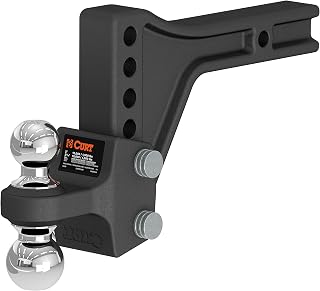 |
CURT 45935 Adjustable Trailer Hitch Ball Mount with Dual Ball, 2" Shank, Up to 15,000 lbs |
$203.77 | (146) | View on Amazon |
| #4 | 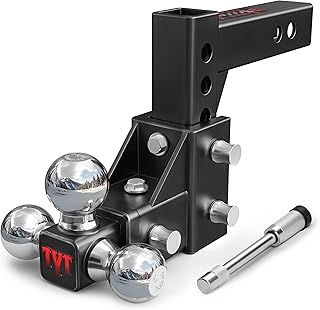 |
TYT Adjustable Tri-Ball Trailer Hitch for 2 inch Receiver, 5" Drop/Rise, Triple Balls (1-7/8", 2", 2-5/16"), 10,000 lbs GTW, 1,000 lbs TW, Includes Hitch Pin Lock & Tri Pins |
$79.99 | (605) | View on Amazon |
| #5 |  |
OPENROAD Adjustable Trailer Hitch Ball Mount, Fits 2-Inch Receiver, 1-Inch Hole, 7500lbs, 9-1/2" Drop/ 8-1/4" Rise Drop Hitch, Tow Hitch for Heavy Duty Truck with Secure Screw-in Pin & R-Clip |
$35.99 | (228) | View on Amazon |