
Best Jump Starters and Battery Boosters for RVs

Jake has spent 8 years full-timing in a Class A motorhome and has personally tested hundreds of RV products across North America. He is the lead gear reviewer at Shop RV Gear, covering solar setups, backup safety syst…
Why trust us
Every product featured on Shop RV Gear is researched by RV owners with real on-road experience. Our lead reviewer Jake Morris has full-timed for 8 years and personally tested gear across 40+ states. We earn a small commission on qualifying purchases — this never influences our picks.
How We Evaluated
We researched and tested the top options, comparing them across key factors including performance, value, ease of use, and reliability. Our recommendations are based on hands-on evaluation and real-world usage data.
⚡ Quick Picks
- #1 8000A 12V/24V Jump Starter for Large Gas & Diesel Engines, Heavy-Duty Portable Battery Booster Pack for Trucks, RVs & Commercial Vehicles with Force Start, Digital Display, LED Light & USB Charging $249.99 View on Amazon →
- #2 Clore Automotive Jump-N-Carry JNC1224 3400/1700 Peak Amp 12/24V Jump Starter $364.96 View on Amazon →
- #3 12V/24V Jump Starter - ZunDian 2800/1400 Amp Heavy Duty Jump Box, Works with Truck Tractor Excavator Automotive Engine Starter Battery Charger Booster Jumper Box with USB/DC Power Unit $249.99 View on Amazon →
Short answer: the best jump starters and battery boosters for RVs
If you camp in anything with wheels and a battery, you need your own jump starter — relying on campground neighbors or roadside assistance is a great way to burn a vacation day.[1][2] For most RVers, a lithium jump pack with real‑world cranking power, solid clamps, and honest safety protections beats a bulky old-school booster box.[2][4] Larger Class A diesels and rigs with 24V systems may need a purpose‑built heavy‑duty pack instead.[8]
After digging through independent testing, RV forum feedback, and current product specs, here’s the bottom line:

- Best overall for most RVers (gas or light‑duty diesel): a mid‑size lithium jump starter with at least ~1,000–1,500 peak amps and a 60–80 Wh battery, from a reputable brand.
- Best for big Class A diesels / 24V systems: a heavy‑duty jump starter that supports 12V and 24V, designed specifically for trucks and buses.[8]
- Best for smaller RVs, vans, and tow vehicles: a compact 800–1,000 peak amp unit that fits in the glovebox.
Below, we’ll walk through specific product‑type recommendations, what specs actually matter, how to size a pack to your rig, and what to avoid.
Pros and cons: lithium vs heavy‑duty vs lead‑acid boxes
| Type | Pros | Cons |
|---|---|---|
| Lithium jump starter | Light, compact, holds charge well, doubles as USB power bank.[2][4] | Some consumer units overstate specs; not ideal for big 24V diesels. |
| Heavy‑duty 12V/24V truck booster | Designed for large diesel engines and 24V systems; robust cables and clamps.[8] | Bulky, heavier, generally more expensive, overkill for small rigs. |
| Lead‑acid booster box | Familiar and rugged; can serve as simple 12V source. | Heavy, self‑discharge faster, not great for small RV storage.[4] |
What to look for in an RV jump starter (and what to ignore)
A jump starter is just a portable battery bank that delivers a high‑current burst to crank an engine.[2] For RV use, you’re buying more than just peak amps — you’re buying reliability on the side of the road.
Key features that matter for RVs
Voltage compatibility

- Most RV chassis and tow vehicles use 12V systems.
- Many diesel pushers and some HD trucks use 24V starting systems, or dual 12V batteries in series.[6][8]
- If you have a 24V chassis, you must choose a jump starter that explicitly supports 24V operation.[8]
Real cranking power, not marketing amps
- Brands throw around “peak amps,” but there’s no universal standard and numbers are often inflated.[4]
- Independent testing and buying guides suggest focusing on cold‑cranking performance and watt‑hour capacity rather than peak‑amp hype.[3][4]
- A practical rule for RVers:
- Gas engines up to full‑size trucks: aim for ≥ 1,000 peak amps.
- Light diesel pickups and Class C’s: 1,500+ peak amps.
- Class A diesels / 24V: a truck‑rated 12V/24V booster.[8]
Battery capacity (Wh)
- Higher watt‑hours = more jump attempts and more usable power for charging phones or running small 12V loads.[3][4]
- For RV use, look for 60–80 Wh or more so you’re not out of juice after a single mistake.
Cable and clamp quality
- Weak, short cables and flimsy clamps are where cheap packs fail.
- RVers using jump packs to run trailer jacks or slides stress the importance of solid clamps and good contact for higher current loads.[7]
Safety features
- At minimum: reverse polarity protection, spark‑proof design, short‑circuit and over‑temperature protection.[2][4]
- These matter if you’re half‑asleep, in the rain, or helping a friend who’s never used a jump pack.
Charging options
- Being able to recharge via 12V DC in the RV, solar, or USB‑C is a big plus so you’re not dependent on shore power.
Specs and features you can mostly ignore
- Wildly high “peak amps” with no test data — often marketing fluff.[4]
- Gimmicky extras like built‑in tire inflators, giant LED light bars, or Bluetooth speakers. They add failure points and size.
- Over‑sized wheels/handles on lead‑acid units if you’re in a small trailer or van — you’ll hate storing it.
3 types of jump starters for RVers
1. Compact lithium jump starters (best for most RVers)
These are the small “power bank” style packs that live in your glovebox. They use lithium‑ion chemistry, so they’re light, hold a charge for months, and often double as USB power banks.[2][4]
Best for:
- Travel trailers, fifth wheels, and campervans (tow vehicle + house battery support)
- Class B and Class C RVs with 12V chassis
- RVers who boondock and want a backup way to run jacks or slides in a pinch[7]
What they do well:
- Jump most gas engines and smaller diesels.
- Power 12V systems briefly (like running an electric tongue jack).[7]
- Charge phones, tablets, and small electronics.
What they don’t do well:
- Crank large displacement diesel pushers with 24V systems.
- Provide long‑duration power; they’re for short bursts and small loads.
2. Heavy‑duty 12V/24V truck jump starters (for big diesel Class A rigs)
These are purpose‑built boosters designed for commercial trucks, buses, and diesel pushers.[8] They often resemble a small booster cart or a large pack with heavy cables.
Best for:
- Class A diesel pushers with 24V or dual‑battery starting systems
- Full‑time RVers who want shop‑grade capability
- Owners who also run medium‑duty trucks or buses
Why they matter:
- Many Class A diesels use 24V starting systems, and standard 12V lithium packs cannot safely boost these.[6][8]
- Heavy‑duty units can deliver the sustained current a big diesel starter demands.[8]
Trade‑offs:
- Bulkier and heavier than consumer lithium packs.
- Usually more expensive, but still cheaper than a roadside call on a remote trip.
3. Traditional lead‑acid booster boxes (old school, still useful in some cases)
These are the cart‑style or suitcase‑style boosters with an internal lead‑acid battery.
Best for:
- Staying mostly in storage or in a big basement bay where size isn’t a problem.
- People who prefer the familiarity of an automotive‑shop‑style booster.
Pros:
- Often robust and simple.
- Can sometimes be used as a small 12V power source.
Cons:
- Heavy and bulky for RV use.
- Self‑discharge faster and require more babysitting than lithium packs.[4]
Best picks by RV rig type
Instead of chasing model numbers that change every year, it’s more useful to match jump starter category and specs to your actual rig. Below is how to choose the right style and power level.
1. Best for travel trailers & fifth wheels (tow vehicle + house battery support)
What you need:
- A compact or mid‑size lithium jump starter capable of starting your tow vehicle’s engine and optionally helping with trailer battery emergencies.
Recommended spec profile:
- Voltage: 12V only is fine.
- Peak amps: ≥ 1,000 A (for half‑tons and gas three‑quarter‑tons).
- Capacity: 60–80 Wh or higher.
- Features: reverse polarity protection, spark‑proof clamps, USB‑A/USB‑C outputs.
Why this works for trailers:
- Your biggest cranking job is usually the tow vehicle’s engine, not the RV batteries.
- A decent lithium pack can also give a tired trailer battery enough help to run jacks or slides in a pinch.[7]
Pros for towable RV owners:
- Light, stows easily in the truck.
- Doubles as a power bank while boondocking.
Cons:
- Not suitable for large 24V diesel rigs.
- Limited ability to run big 12V loads for long periods.
2. Best for Class B and Class C RVs (van and cutaway chassis)
What you need:
- A stronger mid‑size lithium jump starter, as many Class C rigs use heavier‑duty 12V systems and may be diesel.
Recommended spec profile:
- Voltage: 12V.
- Peak amps: 1,200–1,500 A, especially for diesels.
- Capacity: 80+ Wh, preferably.
- Features: robust clamps, 12V output, USB ports.
Why this works:
- Still compact, but with more reserve power to handle larger alternators and diesel starters.
- Useful as a backup power source for 12V loads if your house bank is low.
Pros:
- Good balance of size and power for Class B/C.
- Can live in a cab compartment for quick access.
Cons:
- Still not enough for big Class A diesel pushers.
3. Best for Class A diesel pushers and heavy rigs
What you need:
- A heavy‑duty jump starter rated for 12V and 24V use, designed for commercial trucks.[8]
Recommended spec profile:
- Voltage modes: 12V and 24V, selectable.[8]
- Design: marketed specifically for diesel trucks, buses, or heavy equipment.
- Features: long heavy‑gauge cables, robust clamps, clear 24V safety labeling.
Why this matters for big rigs:
- Many diesel pushers use two 12V batteries in series (24V) for the chassis.[6] A standard 12V jump pack is not compatible.
- Heavy‑duty units deliver the current and voltage your starter expects, reducing risk to expensive electronics and starters.[8]
Pros:
- Capable of starting big diesels.
- One tool can serve your coach and any towed heavy vehicle.
Cons:
- Larger and heavier than consumer packs.
- Overkill for small RVs.
4. Best backup for small campers, vans, and car‑towed rigs
If you drive a small van conversion, teardrop, or car‑towed mini trailer, you can go even smaller.
What you need:
- A compact 12V lithium jump pack sized for your car or small van engine.
Recommended spec profile:
- Peak amps: around 800–1,000 A (check against your engine size).
- Capacity: 40–60 Wh.
Pros:
- Tiny and light enough to live in the glovebox.
- Doubles as a day‑trip power bank.
Cons:
- Not suitable if you upgrade to a larger truck or diesel later.
Real‑world RV uses for a jump starter (beyond dead engines)
Experienced RVers quickly discover that a jump starter is handy for more than starting engines.[1][7][9]
Common use cases:
- Powering trailer tongue jacks and stabilizers when your house battery is weak.[7]
- Running slide‑outs in an emergency (if the current draw is within the pack’s limits).
- Powering basic 12V systems temporarily: lights, water pump, or furnace fan, as confirmed by multiple RVers using jump packs this way.[7]
- Charging phones, tablets, and small electronics while boondocking.[1][9]
- Backup power during storage to test systems without reinstalling a house battery.
RV owners in forums also report using jump packs to help neighbors in campgrounds and to start generators whose starter batteries have gone flat.[5][7]
How to size a jump starter to your RV
Follow this simple approach to avoid over‑ or under‑buying.
Identify your chassis battery voltage (12V vs 24V)
- Check your chassis battery bank: two long 12V batteries in series (pos to neg) often indicate 24V.[6]
- If your manual or tech labels mention 24V systems, you need a 24V‑capable booster.[8]
Check your engine type and size
- Gas vs diesel, and displacement (e.g., 6.8L V10 gas vs 6.7L diesel).
- Larger diesels and high‑compression engines need more cranking current.
Match to a category:
- 12V gas up to full‑size pickup / Class C → mid‑size lithium (1,000–1,500 peak amps).
- 12V diesel (light/medium) → high‑end lithium or smaller truck pack.
- 24V diesel pusher → heavy‑duty 12V/24V truck booster.[8]
Add a margin of safety
- Choose a pack rated above your minimum needs, especially for cold‑weather starting.
Plan where it will live
- If it has to live in a small truck cab or van, prioritize compact lithium.
- If you have big basement bays on a Class A, a heavier truck booster is fine.
How to safely use a jump starter on an RV
Using a jump starter on an RV is similar to a car, but you need to be more aware of multiple battery banks and higher currents.[6][7][10]
General safety steps
Read your RV and jump starter manuals
- Some coaches have battery disconnects or boost switches that change how you should connect.
Identify the correct battery bank
- Engine batteries (chassis) start the engine.[6]
- House batteries run the living area.[6]
- Jump the bank that’s actually causing your problem.
Connect in the correct order
- Positive clamp to positive terminal on the dead battery.
- Negative clamp to a clean engine or chassis ground, away from fuel lines.[2][10]
Let the pack pre‑charge briefly (if recommended)
- Some units allow a short pre‑charge before cranking, which helps with deeply discharged batteries.[4][10]
Crank in short bursts
- Follow your jump pack’s instructions — usually 3–5 seconds at a time, with rest periods to avoid overheating.[4]
Disconnect in reverse order
- Remove negative clamp first, then positive.
Special RV considerations
- 24V caution: Never hook a 12V‑only pack to a 24V chassis battery bank — you can damage the pack and vehicle electronics.[6][8]
- Using a jump pack on a trailer battery:
- Many RVers safely use jump packs to run jacks and basic 12V systems short‑term, as confirmed in forum discussions.[7]
- Ensure the load is within the pack’s continuous current rating.
- Solar and converters:
- If you have solar or a converter running, be aware you may be combining multiple charge sources. When in doubt, disconnect the other sources while jump‑starting.
Common mistakes RVers make with jump starters
- Buying purely by peak amp claims, ignoring real‑world testing and capacity.[3][4]
- Forgetting about 24V systems on diesel pushers and buying an incompatible 12V pack.[6][8]
- Letting the jump starter sit for a year without charging — all chemistries need periodic top‑ups.[4]
- Using tiny clamp contact on big lugs, which causes heat and poor performance.
- Relying on a jump pack instead of fixing bad batteries or parasitic draws — it’s a backup, not a permanent solution.
What to skip (and why)
Ultra‑cheap no‑name lithium packs with huge claimed amps
- Often lack real protection circuits and use inflated numbers.[4]
Combo “does everything” boxes with compressor, inverter, and big lights
- Jack‑of‑all‑trades, master of none; more failure points and bulk.
12V‑only packs for known 24V rigs
- Wrong tool for the job, and potentially unsafe for 24V chassis.[6][8]
Old, neglected booster boxes with sulfated lead‑acid batteries
- Many RVers find their old booster is dead the one time they need it because it wasn’t maintained.[4]
Frequently asked questions
How often should I charge my RV jump starter?
Most manufacturers suggest topping off lithium jump starters every 3–6 months to maintain health, even if they hold a charge well.[4][10] If you camp often, get in the habit of charging it after each trip so you always start with a full pack.
Can I use a jump starter to run my RV overnight?
Generally, no. Jump starters are designed for short high‑current bursts and brief 12V loads, not as full‑time house batteries.[4] You can run lights, a water pump, or a tongue jack for short periods, but they lack the capacity for overnight furnace or fridge duty. For that, you need a proper house battery bank.
Is it safe to jump my RV trailer battery with a jump starter?
Yes, if done correctly and within the pack’s limits. Multiple RVers safely use jump packs to power electric jacks and basic 12V systems when their trailer battery is too low.[7] Connect positive to positive, negative to a good ground, and avoid long, high‑draw usage that could overheat the pack.
Do I really need a jump starter if I have roadside assistance?
If you boondock, camp off‑grid, or travel in remote areas, a jump starter is cheap insurance. RV writers and experienced owners emphasize that having your own jump pack means you can fix a dead battery in minutes instead of waiting hours for a service truck — or trying to maneuver a toad or neighbor’s rig into position for jumper cables.[1][5][9]
Can I charge my jump starter from my RV’s 12V system or solar?
Most modern jump starters support 12V DC or USB‑C charging, which you can power from your RV’s converter or solar‑charged house bank.[2][9][10] Check your specific model’s inputs and charging requirements, but many RVers routinely keep their packs topped off this way while traveling.
All Picks & Comparison
| # | Product | Price | Rating | ||
|---|---|---|---|---|---|
| #1 |  |
8000A 12V/24V Jump Starter for Large Gas & Diesel Engines, Heavy-Duty Portable Battery Booster Pack for Trucks, RVs & Commercial Vehicles with Force Start, Digital Display, LED Light & USB Charging |
$249.99 | (309) | View on Amazon |
| #2 |  |
Clore Automotive Jump-N-Carry JNC1224 3400/1700 Peak Amp 12/24V Jump Starter |
$364.96 | (730) | View on Amazon |
| #3 | 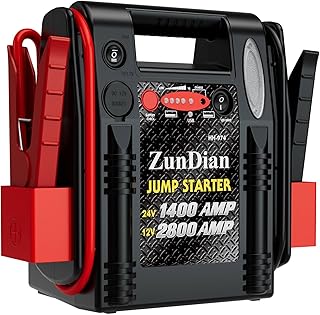 |
12V/24V Jump Starter - ZunDian 2800/1400 Amp Heavy Duty Jump Box, Works with Truck Tractor Excavator Automotive Engine Starter Battery Charger Booster Jumper Box with USB/DC Power Unit |
$249.99 | (34) | View on Amazon |
| #4 |  |
M7 SmartIgnition Jump Starter with Air Compressor, TÜV Certified 12V Car Battery Booster Pack, Portable Tire Inflator, Jump Box, 60Wh Power Bank, for 10L Gas and 8.5L Diesel |
$179.99 | (421) | View on Amazon |
| #5 |  |
VTOMAN X1 Jump Starter with Air Compressor, Car Battery Jumper Starter (Up to 8.5L Gas/6L Diesel Engine) with 150PSI Auto Tire Inflator, 12V Portable Booster Pack, Lithium Jump Box Charger-Black |
$69.99 | (3,187) | View on Amazon |